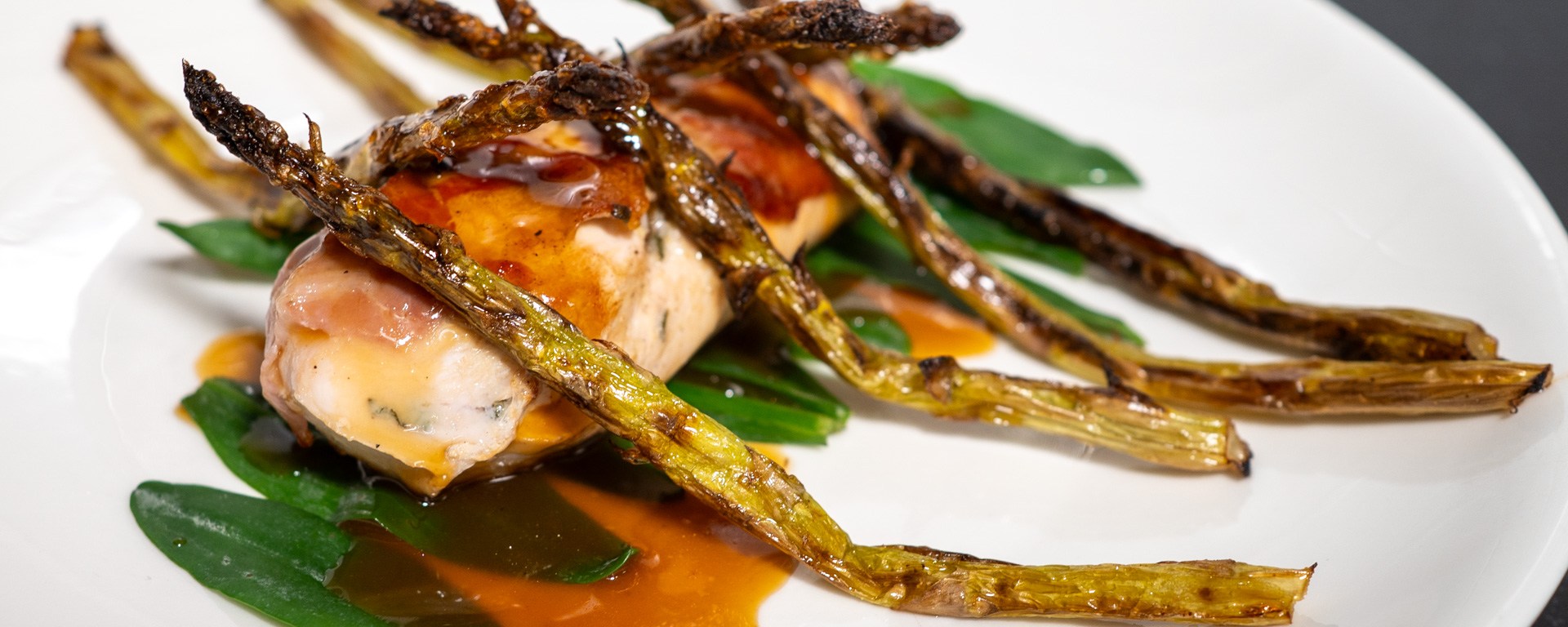

For the reunion of our wine trip to Friuli I’m preparing some dishes inspired by dished we had during the trip. At Michelin-starred Trattoria al Cacciatora we had rolled guinea fowl with “sclopit” and “urticions”. Both of the latter are the names in Friulano of local spontaneous herbs that are not available here in the Netherlands. Instead of sclopit (silene vulgaris) I used sea lavender, and instead of urticions (hops) I used green asparagus. As the breast of guinea fowl is light in flavor and dries out easily, I decided to make a jus from the carcasses of the guinea fowl to go with the dish. I wrapped the guinea fowl in prosciutto with just a bit of fresh sage. Instead of grilling at the restaurant I cooked the meat sous vide, so it came out more tender and juicy. The result was wonderful. The resulting dish is by no means supposed to be a copy, it was just loosely inspired by the one we had during the trip.
Ingredients

Serves 4
- 1 guinea fowl + 2 guinea fowl breast fillets (so 4 breast fillets in total)
- 1 onion, 1 stick celery, 1 carrot, chopped (about 50 grams each)
- 2 slices of prosciutto, preferably San Daniele or Parma
- 1 bunch of green asparagus, preferably thin ones
- 4 fresh sage leaves, minced
- salt and freshly ground black pepper
- olive oil
- 50 grams sea lavender
Instructions

Divide the guinea fowl into breast fillets (without skin), legs, wings, and carcass. Reserve the legs for another use (I’d cook them sous vide for 24 hours at 60C/140F).

Preheat the oven to 190C/375F. Place the wings, carcass, and skin in an oven dish, and roast at 190C/375F for about 30 minutes or until golden brown.

In the meantime, season the breast fillets lightly with salt and freshly ground black pepper on both sides, and sprinke with fresh minced sage on one side.

Roll up the breast fillets on an angle such that you obtain a roll with more or less even thickness, and wrap each roll with half a slice of prosciutto.

To ensure the rolls will stay together when you vacuum seal them, wrap them in heat-resistant plastic (the same as sous vide bags).

Vacuum seal the rolls, and allow to rest in the refrigerator for at least 1 hour.

When the guinea fowl carcass has finished roasting in the oven, transfer the pieces to a stock pot or pressure cooker. Deglaze the roasting tray with boiling water, scraping with a spatula to get all of the drippings that got stuck to the roasting tray. Add that water to the pot. Add chopped onion, carrot, and celery as well, and add more water to barely cover the contents of the pot.

Cover and bring to a boil, then reduce the heat and simmer for 3 hours. If using a pressure cooker, bring to pressure, and pressure cook for 1.5 hours.

After that, filter the stock with a fine sieve.

If you have the time, the easiest way to separate the fat from the stock is by allowing the stock to cool to room temperature, and then chill it in the refrigerator until the fat that floats on top has solidified. You can then easily scoop it off with a spoon (and reserve it to brown the meat later). The fat will also float on top when the stock is still hot, so you can try to spoon it off then, but that is not as easy to do without getting a lot of the stock, too.

Pour the stock into a low wide pan, bring to a boil, and then simmer…

…until the stock has been reduced to a nice guinea fowl jus, about 125 ml (1/2 cup).
Up until this point, the dish can be prepared in advance.

To finish the dish, cook the guinea fowl sous vide at 60C/140F for 1 hour.

Meanwhile, preheat the oven with broiler to 225C/450F. Break the tough woody bottoms off the asparagus. Place them in a bowl, drizzle with olive oil, season with salt, and toss until the asparagus are covered with a thin layer of oil.

Broil the asparagus until they are nicely browned and tender, turning them as soon as the top looks browned. This will take 10-20 minutes and you should watch them carefully as they can go from perfect to burnt very quickly.

Remove the steams from the sea lavender.

Blanch the sea lavender for just 10 seconds in boiling water, then drain, and cool them off in cold water.

When the guinea fowl has finished cooking sous vide, take the rolls out of the bag, remove the plastic, pat them dry with paper towels, allow them to cool for a couple of minutes, and then brown them quickly on all sides over high heat in olive oil (or reserved guinea fowl fat from making the stock!) in a non-stick pan. (My favorite non-stick pans are carbon steel frying pans that develop natural non-stick properties by using (seasoning) them. Just wash them with hot water and dry with paper towels.)
To serve, place a row of sea lavender leaves on a preheated plate. Place a roll of guinea fowl on top, topped with the asparagus. Finish by pouring 2 tablespoons of guinea fowl jus on top.
Wine pairing
This is great with either a full-bodied oaked white like Chardonnay, or a lighter red like a Pinot Noir. As the dish is inspired by a restaurant from Friuli and we had a Schioppettino with that dish at the restaurant, a Schioppettino (a local red variety that is sometimes called the Pinot Noir of Friuli) would be an excellent and original choice.


Different! Elegant! Simple! Beautifully served but, sadly, for me just a read and a mental attempt to taste 🙂 ! Guinea fowl is not easily available Down Under and I have never heard of sea lavender here. Our asparagus stems never seem to be as slim . . . I love the vegetable but mostly steam it . . .
LikeLiked by 1 person
It’s a beautiful presentation, and sounds delicious!
LikeLiked by 1 person
Great dish! I’ve never heard of sea lavender. How does it taste?
LikeLiked by 1 person
It grows in brackish areas near the sea that get flooded once in a while. So no surprise it is slightly salty. Otherwise it just taste like you would expect from a grean leaf that is relatively sturdy but tender (about the thickness of bay leaf but flexible rather than brittle).
LikeLiked by 1 person