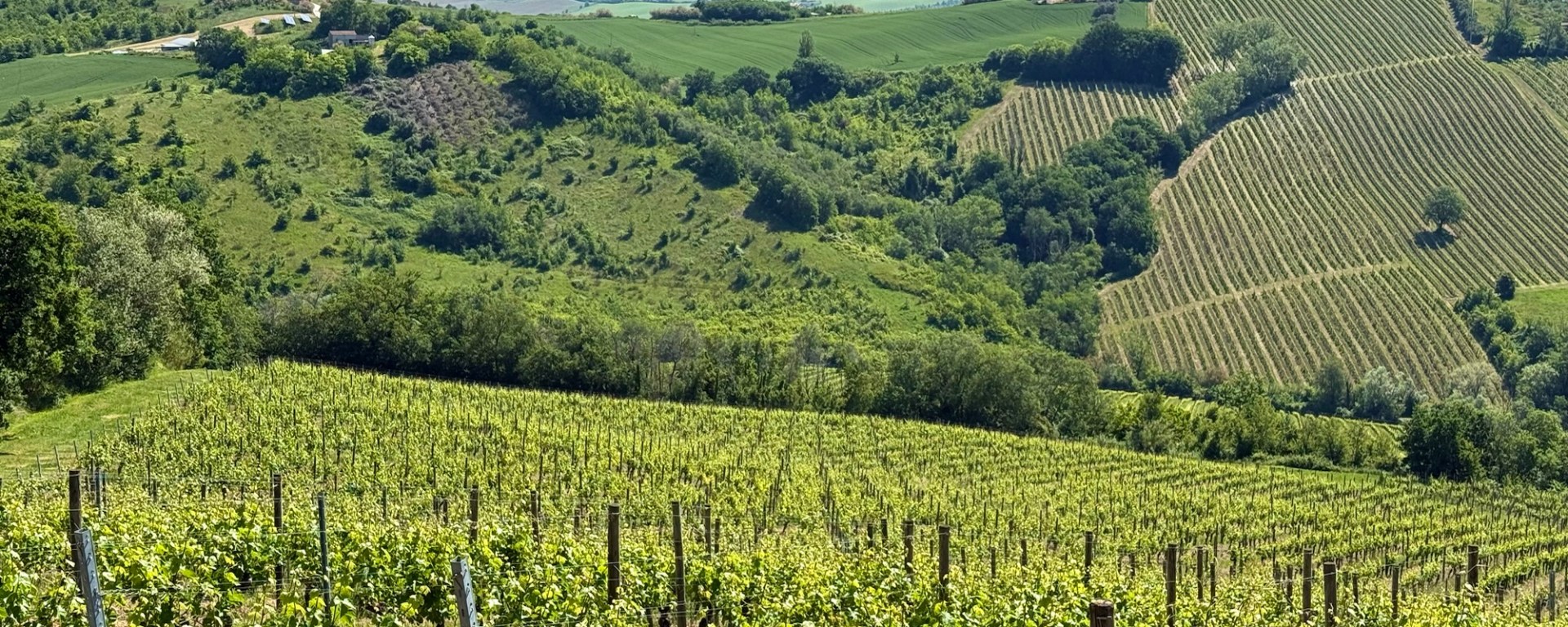
As a member of the Dutch association of wine connoisseurs with a level 4 diploma (Verenigde Vinologen Nederland), I serve on the VVN travel committee. Together with Fred Nijhuis, I organize wine trips to Italy. Following our previous journeys to Campania in 2024 and Friuli in 2025, we are visiting Emilia-Romagna and the Marche this year. Both are lesser-known Italian wine regions, which is precisely what makes them so interesting to explore.
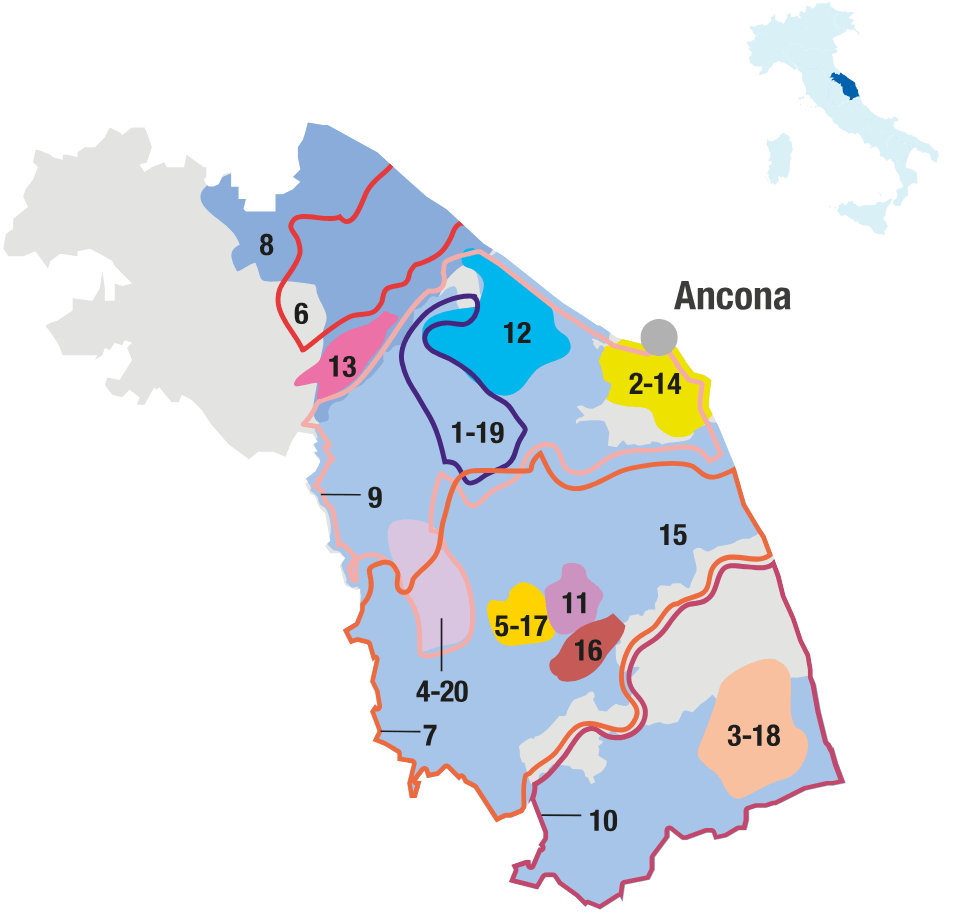
After our first day in Emilia focusing on Lambrusco, the morning of the second day featuring Pignoletto, and the afternoon of the second day as well as the whole third day dedicated to Romagna, our final stop was Le Marche. This wine region on the Adriatic coast is most famous for the whites of Verdicchio, with Castelli di Jesi Verdicchio Riserva DOCG (1), Verdicchio dei Castelli di Jesi DOC (19), Verdicchio di Matelica Riserva DOCG (4), and Verdicchio di Matelica DOC (20) as the most important appellations. The numbers in parenteses refer to the map. For red Conero DOCG (2), Rosso Conero DOC (14), and Rosso Piceno DOC (15) are the most important, with Montepulciano and Sangiovese as the dominant black grape varieties.
For Verdicchio the main distinction to make is between the zones of Jesi and that of Matelica. Jesi is heavily influenced by the Adriatic Sea, which keeps the climate relatively warm and constant, yielding wines characterized by rounder fruit profiles, salinity, and the grape’s signature bitter almond finish. Matelica is situated further inland, tucked against the Apennine Mountains in a landlocked valley. This makes the climate more continental, with large diurnal temperature swings, leading to wines with more crispness and minerality.
On the labels you can also find the terms Classico, Superiore, and Riserva. Classico only refers to Jesi and means the grapes are from the historic heartland of the zone that contains the best vineyard sites. Superiore is also only used for Jesi and requires a higher minimum alcohol content (12% instead of 11.5%) and a lower maximum yield. Riserva means that the wines have aged for a minimum of 18 months (including bottle age), and this designation upgrades the appellation from DOC to DOCG. The aging does not have to be in wood, and most producers use stainless steel, concrete, or large neutral oak barrels that do not impart oaky flavors or aromas.
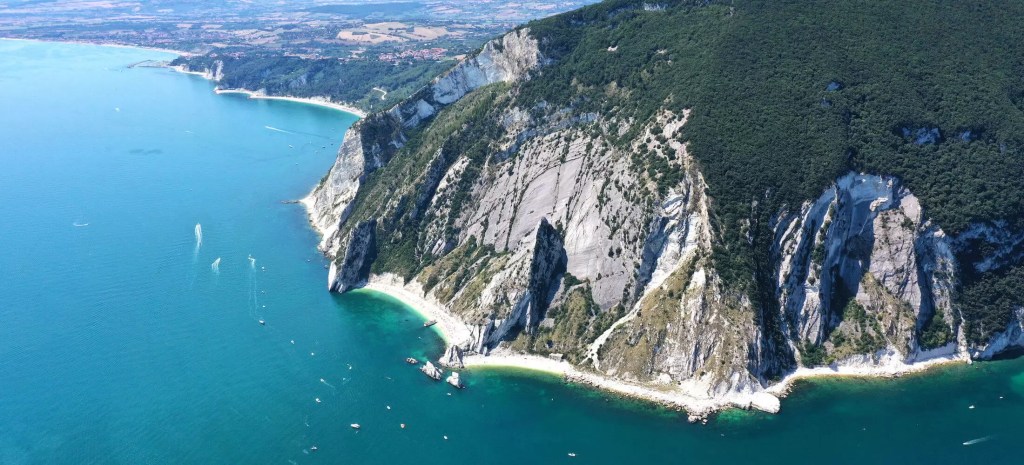
Rosso Conero DOC and Conero Riserva DOCG are for red wines from Mount Conero, a dramatic limestone promontory that juts directly into the Adriatic Sea just south of Ancona. The marine limestone soils combined with the cooling sea breezes give these wines an intense chalky minerality, high tannins, and a plush, dark fruit profile with notes of black cherry, plum, and wild herbs. Most wines are 100% Montepulciano, but up to 15% Sangiovese is permitted. The Riserva must be aged for at least 2 years, including at least 12 months in wood barrels. Rosso Piceno is always a blend of Montepulciano (35% to 85%) and Sangiovese (15% to 50%), with other non-aromatic black grapes allowed up to 15%. Because of the higher percentage of Sangiovese, Rosso Piceno generally tends to be brighter, more rustic, and higher in acidity than Rosso Conero, balancing Sangiovese’s red cherry and earthy notes with Montepulciano’s dark fruit and body. Geographically speaking, it makes sense that Le Marche produces a blend of Sangiovese (the signature black grape from Romagna to the north and Tuscany to the west) and Montepulciano (the primary black grape of Abruzzo to the south).
Sot’ aj Archi
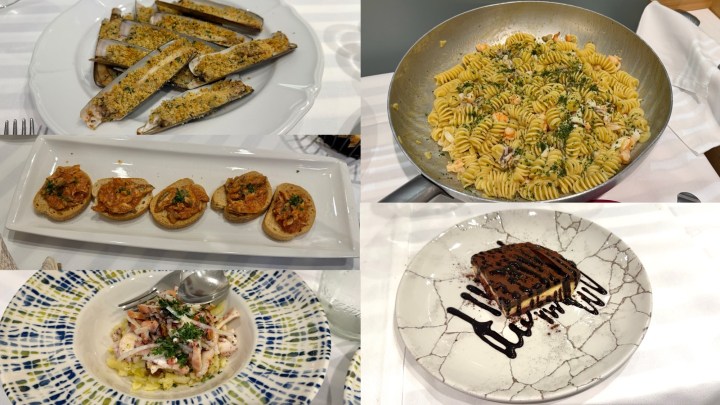
We arrived in Ancona in the evening, so we started our visit to Le Marche with dinner at restaurant Sot’ aj Archi. The antipasti included an octopus and potato salad with raisins and Tropea onions, crostini with sardines in tomato sauce, and gratinéed razor clams. The fusilli “misto mare” was elegant and perfectly al dente, tossed with shrimp, vongole, and calamari. We finished with dessert, with most of us choosing zuppa inglese. This traditional regional dessert consists of layers of sponge cake (pan di spagna) soaked in liqueur and espresso, layered with lemon-infused pastry cream and dark chocolate custard.
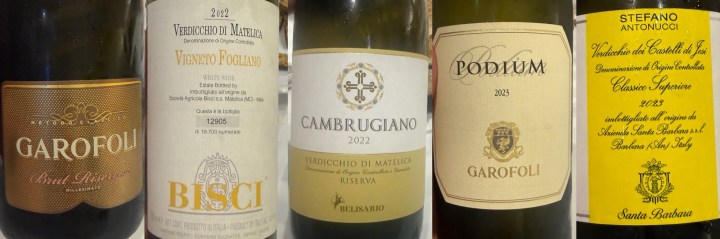
The wines we had with dinner were:
- Garofoli, Verdicchio dei Castelli di Jesi Metodo Classico Brut Riserva DOC 2021, aged 48 months on the lees.
- Bisci, Vigneto Fogliano Verdicchio di Matelica DOC 2022, from a single vineyard with 40-year old vines.
- Belisario, Cambrugiano Verdicchio di Matelica Riserva DOCG 2022, made with skin contact and aging in oak.
- Garofoli, Podium Verdicchio dei Castelli di Jesi Classico Superiore DOC 2023, aged in stainless steel on the lees for 15 months.
- Santa Barbara, Stefano Antonucci Verdicchio dei Castelli di Jesi Classico Superiore DOC 2023.
Villa Bucci
Our first stop for Verdicchio dei Castelli di Jesi was at Villa Bucci, without a doubt the most famous producer of Verdicchio that put the wine on the map as an age-worthy white wine. While the family has been farming in Le Marche since the 1700s, the modern wine legend was shaped by the iconic Ampelio Bucci. He was a pioneer who swam against the current when the rest of the region was mass-producing cheap white wine in amphora-shaped bottles. Ampelio has passed away, but his legacy continues.
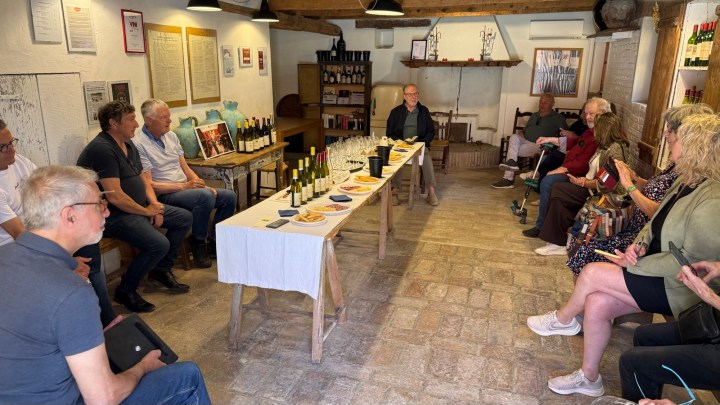
The estate covers 26 ha (65 acres) of vineyards in the Castelli di Jesi Classico zone and was a very early adopter of certified organic farming. The vines for their top wine, Villa Bucci, are old (over 40 to 50 years), giving the wine more depth of flavor and concentration. Rather than new oak, the wine is aged in large casks of Slavonian oak that allow for a slow micro-oxygenation that gives the wine structure without imparting oak flavors. Villa Bucci has a reputation for being able to age for decades.
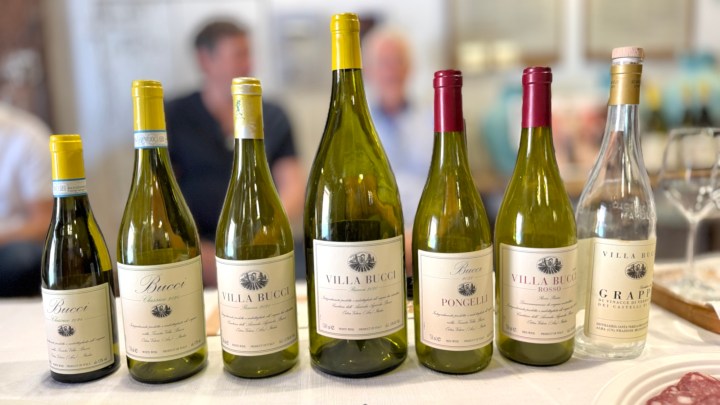
We tasted the full lineup of their wines:
- Bucci Verdiccio dei Castelli di Jesi Classico Superiore DOC 2024: clean and fresh.
- Villa Bucci Verdicchio Riserva DOCG 2021. The flagship wine, of which unfortunately we only tasted the current vintage. This wine is only made from their oldest vines in the best vintages. It spends roughly 1.5 to 2 years in the old Slavonian casks followed by significant bottle aging before release. Structure, complex, full body, still young.
- Tenuta Pongelli Rosso Piceno DOC 2023, a blend of 50% Sangiovese and 50% Montepulciano. Balanced and fresh with velvety tannins.
- Villa Bucci Rosso Rosso Piceno DOC 2020, a blend of 70% Montepulciano and 30% Sangiovese, aged for 12 months in large oak barrels. Deep dark frui, ripe tannins.
Sartarelli
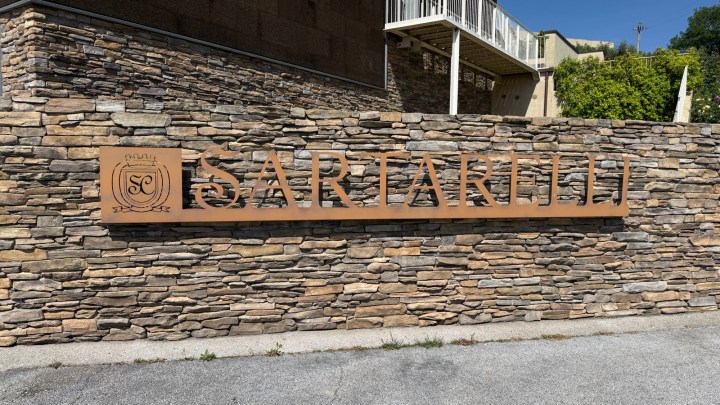
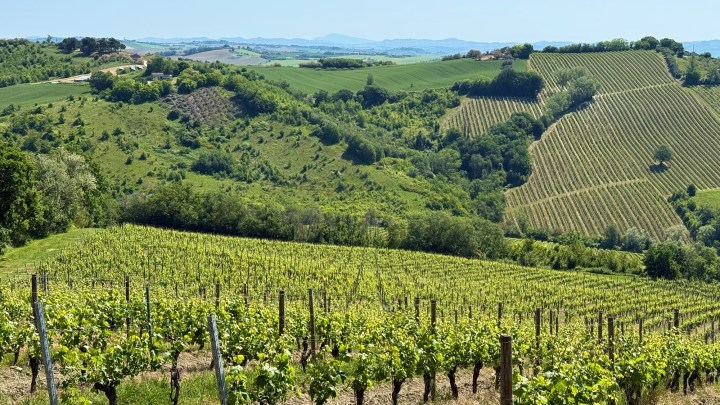
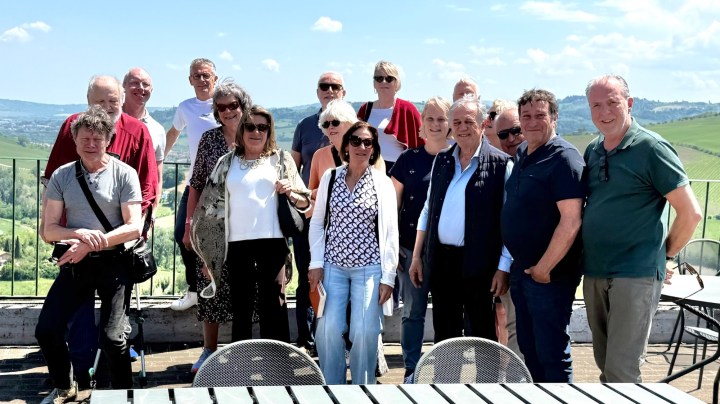
Our next stop was at Sartarelli, a beautiful estate with a great view and a modern building with a small museum.
We were received by Patrizio Chiacchiarini, who joined his father-in-law Ferruccio Sartarelli in the late 1970s and took the reins of the family business full-time in 1990. Sartarelli focuses exclusively on Verdicchio. However, their wines showcase such different expressions of the grape variety that their line-up is still quite diverse. Sartarelli has chemical-free vineyards, by using natural products (resistance inducers) to ensure that no residues of synthetic chemical molecules are found either in the primary products (the grapes) or in the finished products (the wines).
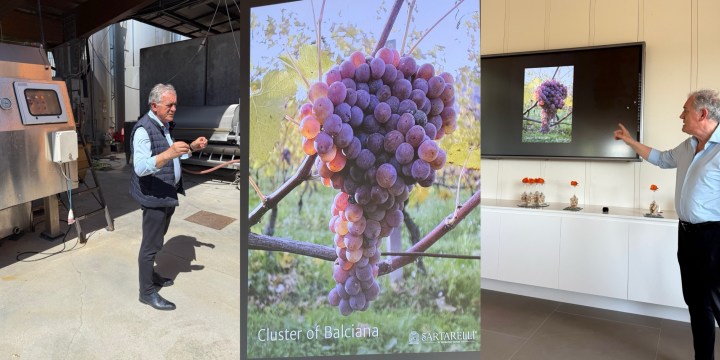
Their Classico is similar to many other Verdicchios, but the other wines are quite different due to late or later harvesting. Their icon wine, Balciana, was named “Best White Wine in the World” at the International Wine Challenge in London in 1999. As Patrizio pointed out while showing a photo, it is made from a late-harvest Verdicchio (November) with the grapes attaining a very dark color and some of them being affected by botrytis. The wine is fermented to dry, so it is very rich with a high alcohol content. Thanks to Verdicchio’s naturally high acidity, it remains balanced despite the late harvest.
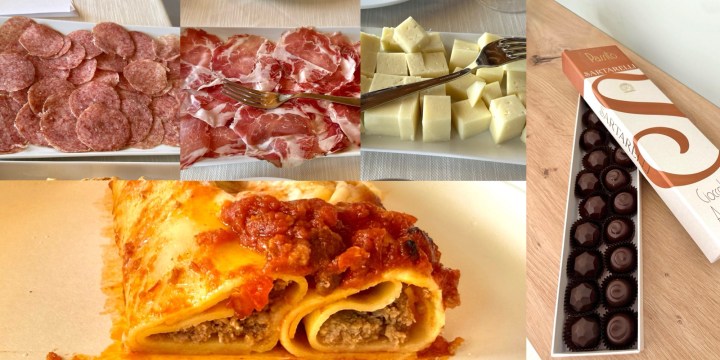
We tasted the wines while enjoying a lunch of salami, coppa, and cheese, followed by Cannelloni alla Marchigiana. This is fresh pasta rolled around a filling of beef and pork, then covered by tomato sauce and baked in the oven. We finished with chocolates filled with Sartarelli’s passito or grappa.
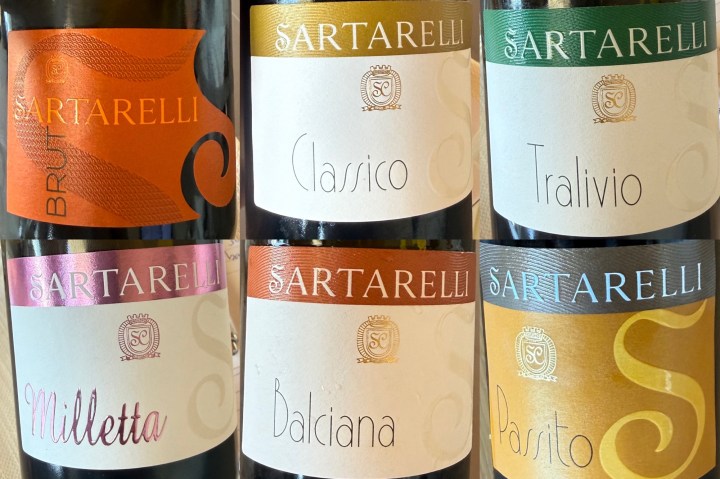
The wines we tasted were:
- Brut Vino Spumante, made with the Martinotti method, 10 g/l residual sugar, fresh and fruity.
- Classico, Verdicchio dei Castelli di Jesi Classico DOC 2025, aged in stainless steel for 4 months, fresh, crisp, and balanced.
- Tralivio, Verdicchio dei Castelli di Jesi Classico Superiore DOC 2024, from a later harvest from older vines on steep slopes. Rich and creamy with low acidity for a Verdicchio.
- Milletta, Castelli di Jesi Verdicchio Classico Riserva DOCG 2022, for the 50th anniversary of the cantina, aged for 2 years, made with 30 hours of skin contact. Aromatic, balanced, almond finish.
- Milletta 2023, same wine from a younger vintage: fresher, more complexity, very nice.
- Balciana, Castelli di Jesi Verdicchio Classico Riserva DOCG 2023, late harvest on November 17 with some botrytis and aged for 1 year on stainless steel. Off-dry with 15.5% alcohol. Very rich and opulent and a good pairing for the cannelloni.
- Passito, Verdicchio dei Castelli di Jesi Passito DOC 2023, late harvest in October and then drying the grapes for 4-5 weeks before a slow fermentation with the skins and aging in stainless steel for 8 months. Outstanding balance between sweetness (100-110 g/l) and acidity. Aromas of figs and orange zest, some tannin from the skins.
We also tasted the Grappa Balciana, made from the skins, pulp, seeds, and stems left over after pressing the grapes for making the Balciana wine.
Borgo Paglianetto
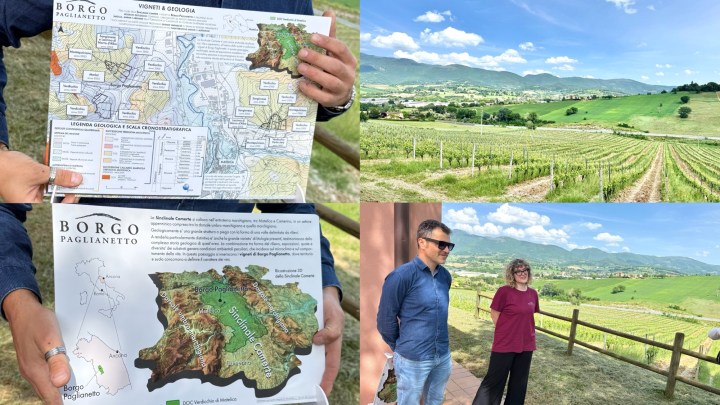
Our next stop was not in the Jesi zone but in the Matelica zone, at Borgo Paglianetto, where we were received by winemaker Francesco Tavolini. The estate was founded in 2003 through a merger of two estates, with the current winery constructed in 2008, and has 24 hectares (60 acres) of vineyards, of which 20 hectares are planted with Verdicchio. Francesco explained that the mountains block the wind from the sea, thus creating a continental climate with a high diurnal range. The soil here is clay and sand. The harvest starts in September with the grapes for the metodo classico (as higher acidity is required to make sparkling wine), continues with the base Verdicchio, and concludes in October with the cru vineyards. The vineyards have good drainage, with the oldest vines being 25 to 40 years old. Many of the clones of Verdicchio are typical for Matelica and are different from those found in Jesi. All the wines are fermented and aged in stainless steel, except for the red Montepulciano, which is aged in large oak casks (25 hl). They practice minimal intervention and avoid techniques like cryomaceration. Like most of the wineries we’ve visited on this trip, Paglianetto practices organic viticulture.
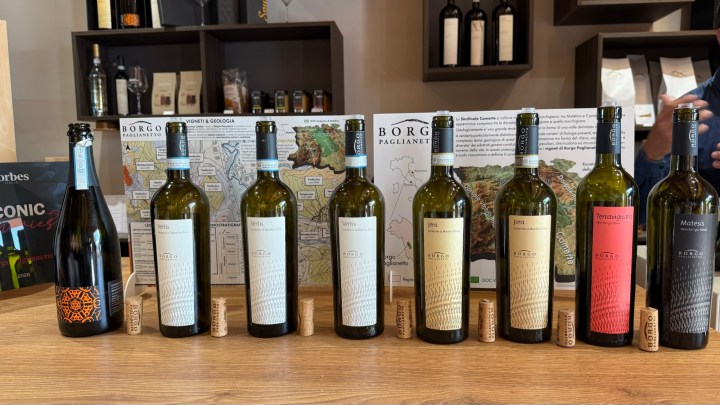
We focused the tasting on a vertical tasting of the flagship wines, Vertis and Jera, but also tasted the sparkling Verdicchio and two of the reds:
- Verdicchio di Matelica Spumante DOC Metodo Classico 2019, aged 48 months on the lees, brut with 5 g/l residual sugar, only 2000 bottles produced. High acidity but balanced, citrus aroma.
- Vertis Verdicchio di Matelica DOC 2021, grapes from the higher part of the hill, aged 18 months sur lie, only 25,000 bottles produced. Structure, body, balance, and what Italians call “sapidità” (best translated as “savoriness”).
- Vertis 2020, same wine with an additional year of bottle age. The 2020 vintage was cooler than 2021, so the wine has higher acidity and is more crisp. The aroma is more pronounced and the best of the three Vertis we tasted.
- Vertis 2019, an even cooler vintage. Very structured, balanced, tertiary notes.
- Jera Verdicchio di Matelica Riserva DOCG 2020, from the top of the hill harvested late at the beginning of October, aged 36 months sur lie. Young, aroma still restrained, although it did open up in the glass. A lot of body and well balanced.
- Jera 2017, same wine from a different vintage and more bottle age. Full body, balanced, good acidity.
- Terravignata Marche Rosso IGT 2024. 50% Sangiovese, 35% Merlot and 15% Lacrima di Morro d’Alba, aged 6 months in stainless steel. Lacrima is a very aromatic local variety that makes this wine perfumed with roses and violets. Fresh and light tannins.
- Matesis Marche Rosso IGT 2019. 100% Montepulciano aged 1 year in a 25 hl oak barrel and then another year in stainless steel. The Montepulciano grapes are harvested at the end of October or early November because of the cooler climate at Matelica. High but ripe tannins, elegant.
Trattoria la Moretta dal 1897
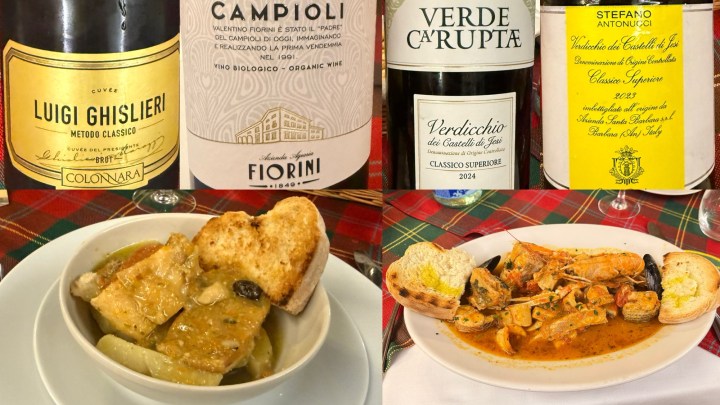
For our last dinner of the trip we went to la Moretta, a historic trattoria from 1897 on the main square of Ancona. Here we had two of the most iconic dishes from Ancona: Stoccafisso all’Anconetana and Brodetto all’Anconetana. Stoccafisso is the Italianization of the Dutch word “stokvis” (stok = stick, vis = fish) for air-dried cod. Even though there was plenty of fresh fish from the Adriatic, they historically also traded in stoccafisso from the Arctic. La Moretta is the keeper of the official recipe, in which the fish is first soaked in water for several days and then stewed with anchovies, celery, onion, carrot, rosemary, capers, Verdicchio, black olives, potatoes, and just a bit of tomato. The flavor is quite pronounced. Brodetto is a fish stew, related to dishes like Bouillabaisse from France and Zarzuela from Spain, which was devised by fishermen to use up small, damaged, or low-value fish and seafood. The version from Ancona should have exactly 13 different species of fish and other seafood in it. Compared to the Stoccafisso, the Brodetto features a lot more tomato. The stew also includes onion, garlic, parsley, and white wine, with the sauce achieving a great depth of flavor from the juices released by all those different types of seafood.
For the wine, we started with a Verdicchio dei Castelli di Jesi Spumante Metodo Classico by Luigi Ghislieri, followed by a Fiorini Tenuta Campioli Bianchello del Metauro Superiore DOC 2024, made from the rare local grape variety Bianchello. We finished with two expressions of Verdicchio dei Castelli di Jesi: the Verde Ca’Ruptae 2024 by Moncaro and the oaked Santa Barbara Stefano Antonucci 2023 that we also enjoyed the day before.
Umani Ronchi
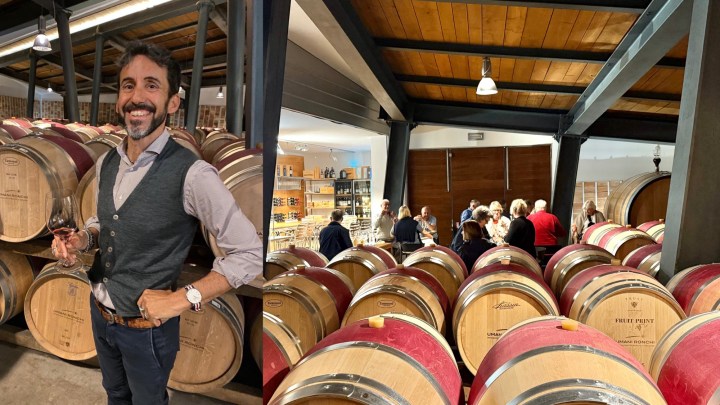
During these wine trips we always try to visit a mix of wineries, from small family businesses to large cooperatives. Our last winery visit was to Umani Ronchi, the largest privately-owned, non-cooperative estate in Le Marche. We were received by sommelier and hospitality manager Andrés Ariza. The estate was founded in 1957 by Gino Umani Ronchi. Although it was taken over by Roberto Bianchi and his son-in-law Massimo Bernetti in 1968, the name remained. The estate manages about 220 hectares of vineyards, all organically farmed, and produces 3 million bottles annually. Besides quantity they also focus on quality. Next to mass-produced entry-level wines, they produce critically acclaimed high-end wines. In 1997, their ‘Super-Marchiano’ Pelago (a blend of Montepulciano, Cabernet Sauvignon, and Merlot) won the International Wine Challenge in London, putting Umani Ronchi and Le Marche on the global map. Umani Ronchi mainly produces wines in Verdicchio dei Castelli di Jesi and Conero, but also operates in Abruzzo. The estate was named Winery of the Year 2024 by Gambero Rosso.
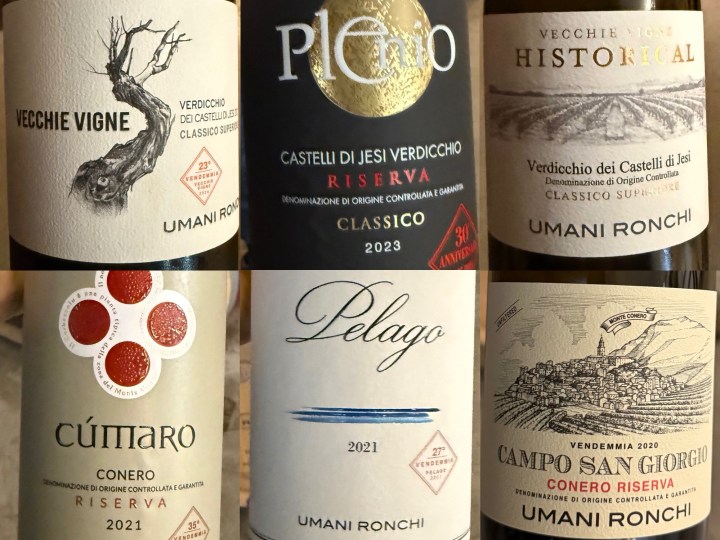
Our tasting at Umani Ronchi included multiple vintages for most of the wines we tasted, which made it an interesting tasting session.
- Vecchie Vigne Verdicchio dei Castelli di Jesi Classico Superiore DOC 2024, from old vines from a vineyard planted in 1968, aged for 10 months on its lees in concrete. High acidity, but body and balance, beautiful fruity aromas like peaches.
- Plenio Castelli di Jesi Verdicchio Classico Riserva DOCG 2023, aged for 12 months on lees in oak barrels, 10% malo. Structured and high acidity, touch of oak.
- Plenio 2020. Complex, structured, fresh,
- Plenio 2008. Golden color, nicely aged, still fresh.
- Vecchie Vigne Historical Verdicchio dei Castelli di Jesi Classico Superiore DOC 2020, aged 18 months in concrete and then 36 months in stainless steel. Full body, creaminess balanced with acidity, needs aeration.
- Cúmaro Conero Riserva DOCG 2021, 100% Montepulciano aged for 12-24 months in small oak barrels of 1-2 years old. Spicy, fresh, earthy, medium body and tannins.
- Cúmaro 2015, high tannin and full bodied from a vintage that was clearly a lot warmer than 2021.
- Pelago Marche Rosso IGT 2021, 50% Montepulciano, 40% Cabernet Sauvignon, 10% Merlot, aged 14 months in small oak barrels of 1-2 years old. Cabernet fruit, medium body and tannin, high acidity.
- Pelago 2013. Tertiary aromas, high acidity, softened tannins, medium body.
- Campo San Giorgio Conero Riserva DOCG, 100% Montepulciano from bush vines with a low yield, aged for 12 months in small oak barrels of 1-2 years old and then 12 months in large oak barrels. Dark fruit, fresh, dry tannins.
- Maximo Marche Bianco IGT, 100% Sauvignon Blanc harvested in three stages between October and December with botrytis. Umani Ronchi selected Sauvignon Blanc rather than Verdicchio to make a Botrytis wine, because the compact bunches of Verdicchio allow Botrytis only to develop on the outside of the bunch. Sweetness (112 g/l) nicely balanced with acidity. Relatively elegant with a complex aroma typical for a Botrytis wine.
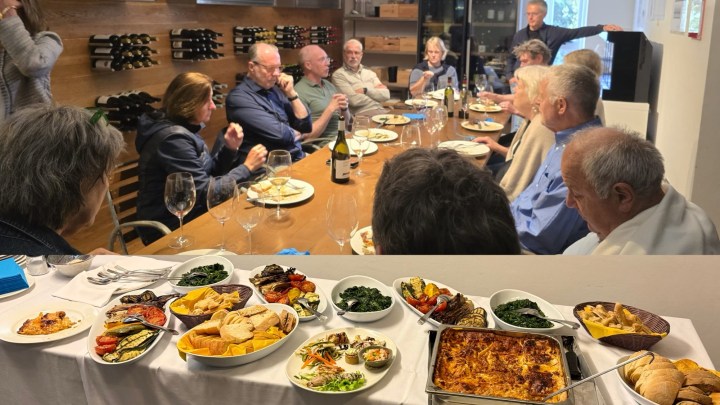
We ended our visit with a nice lunch that included Lasagne alla Marchiana, accompanied by our favorite wines from the tasting.


A perfect time of year for the tour!
LikeLiked by 1 person