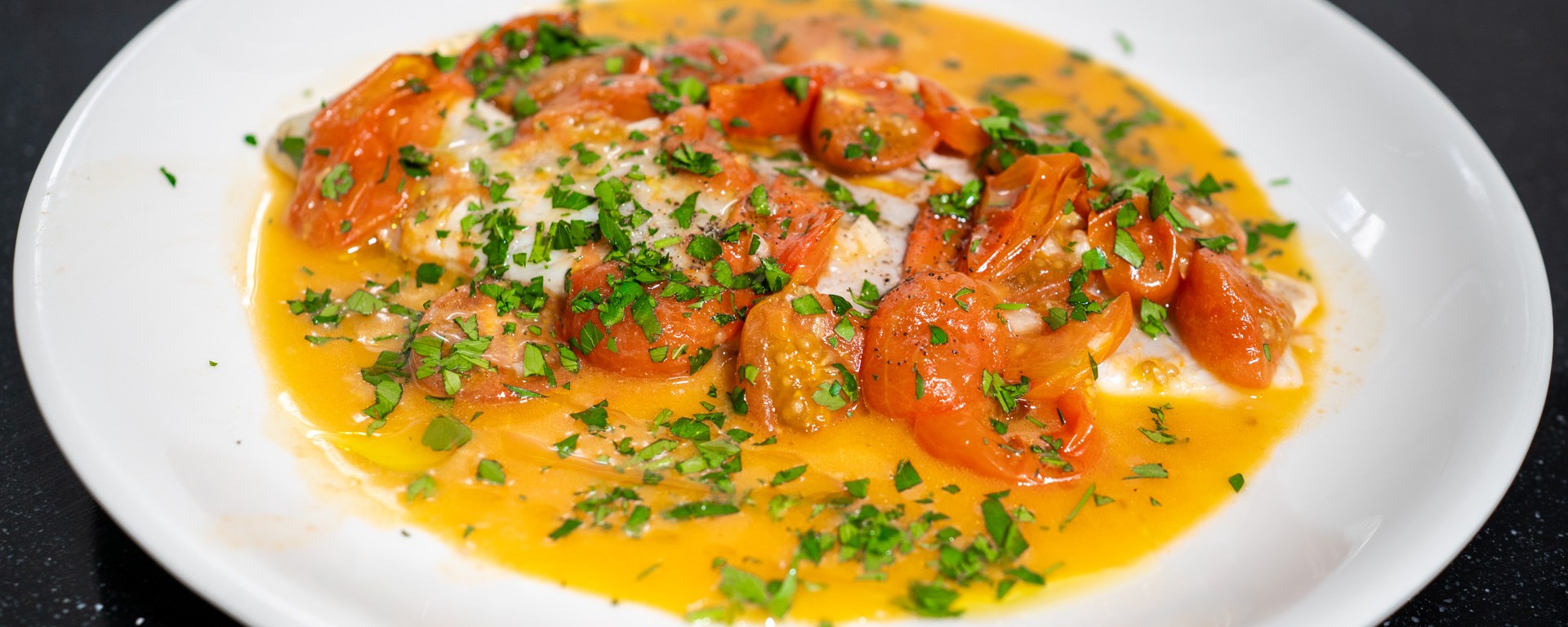
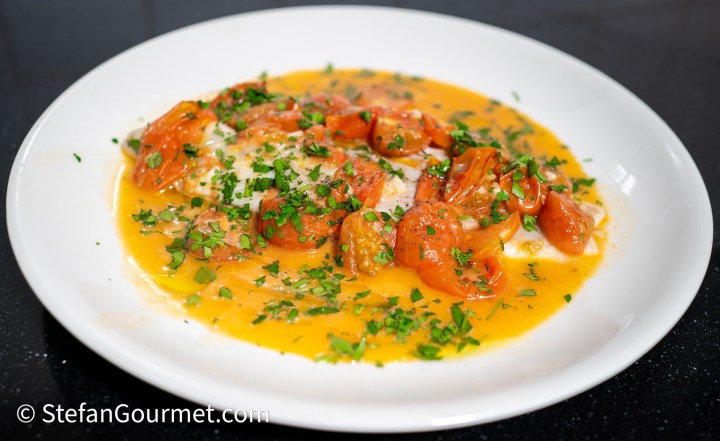
If you haven’t yet decided what to make for Christmas dinner and are looking for an easy yet elegant fish dish that requires only about 30 minutes of prep and 10 minutes to finish, Branzino all’Acqua Pazza may be exactly what you are looking for. Despite its rustic origins, this is a sophisticated dish where a light, herbaceous broth perfectly complements the delicate white flesh of the fish.
What makes it even better for Christmas is that you only need a few ingredients and it is perfectly fine to use frozen branzino fillets; this allows you to purchase the fish in advance and keep it fresh in the freezer. Simply ask your fishmonger to fillet the fish and package the fillets separately from the heads and bones. You can then freeze the heads and bones as they are, or turn them into stock and freeze that instead. Just remember to allow the fillets to thaw gently overnight in the refrigerator before cooking.
“Acqua Pazza” is Italian for “crazy water”, and there are several anecdotes regarding the origin of the recipe and its name. The most common theory is that during multi-day trips, fishermen from the island of Ponza would cook their catch using seawater and cherry tomatoes. Seawater was a readily available alternative to salt, which was once a heavily taxed and expensive commodity. In fact, the word “salary” is derived from the word for salt because Roman soldiers were famously paid a “salt allowance”—a sum provided specifically to purchase this vital mineral. While cooking in seawater might be considered a ‘crazy’ practice today, there are several other theories about the name’s origin. Regardless of its birth on fishing boats, it was the restaurants of Naples and Capri that made the recipe world-famous in the 1960s, using the catchy name to appeal to tourists.
The standard restaurant version involves poaching the fish with olive oil, garlic, cherry tomatoes, white wine, water, salt, and pepper. A high-quality restaurant version typically uses the whole fish to enrich the broth with flavor extracted from the head. However, cooking a whole fish requires a longer simmer, which carries the risk of overcooking the cherry tomatoes. Conversely, because many diners prefer boneless fillets, restaurants often skip the whole fish, sacrificing the depth of flavor found in a true fish broth.
My version offers the best of both worlds: I make a fish stock from the head and bones, reduce it, and use it in place of water. I then poach the fillets in this enriched broth so guests don’t have to navigate bones at the table. I have introduced further enhancements to perfect the dish: salting the fillets in advance acts as a dry brine to firm up the flesh and improve flavor, and I cook the fish using only the residual heat of the broth rather than boiling it to ensure the texture remains incredibly juicy.
In Italy, the most common fish used for this preparation are branzino (known as spigola in Central and Southern Italy) and sea bream (orata). Branzino is generally more forgiving than sea bream, which is leaner and can become dry more easily. Branzino is also widely known as European sea bass or Mediterranean sea bass. If you cannot find branzino or sea bream, excellent substitutes include striped bass (USA), black sea bass (USA), or snapper.
Ingredients

Serves 4
- 2 branzinos (approx. 600g / 1.3 lbs each), filleted, with heads and bones reserved for stock
- 100g (3.5 oz) each of onion, carrot, and celery, roughly chopped for the stock
- 500g (1.1 lbs) cherry tomatoes, halved
- 120ml (1/2 cup) dry white wine
- 2 cloves garlic, minced
- 2 Tbsp fresh flat-leaf parsley, minced
- 3 Tbsp extra virgin olive oil, plus more for drizzling
- salt and freshly ground black pepper, to taste
Instructions
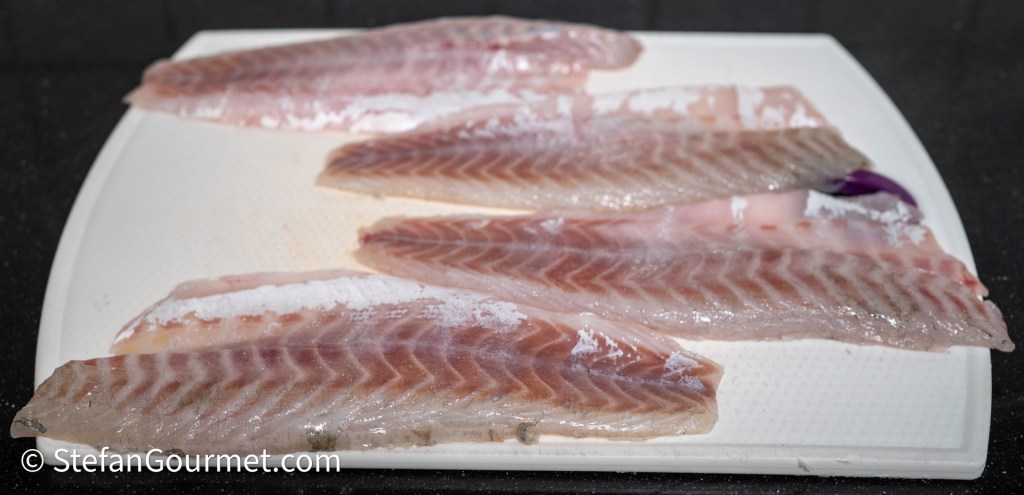
Season the branzino fillets on both sides with salt. Cover with plastic wrap and allow the fish to firm up in the refrigerator for at least 30 minutes.
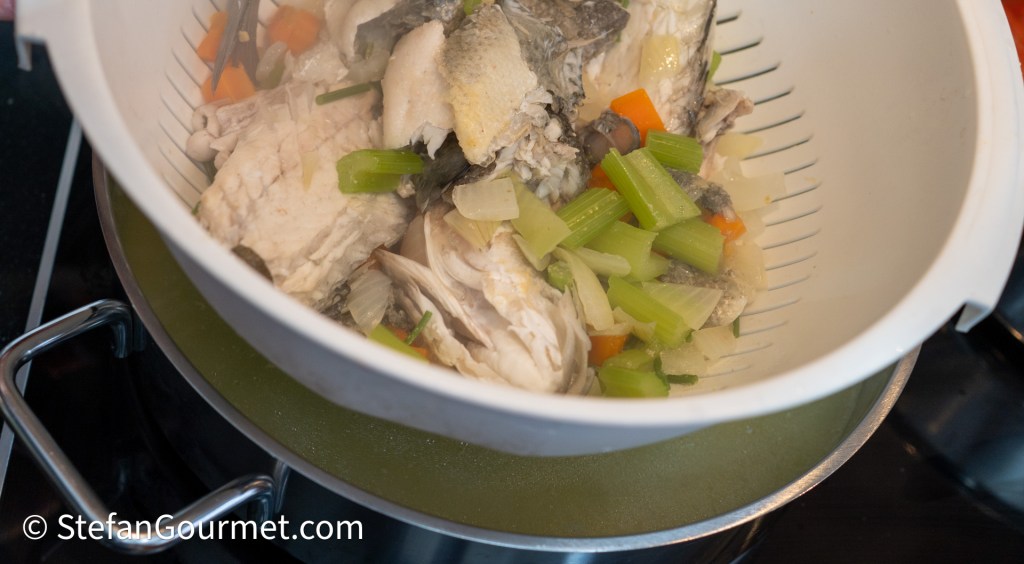
While the fish is resting, prepare the stock. Begin by removing the eyes, gills, and any innards from the heads, then rinse the heads and bones thoroughly under cold running water. Place them in a pot and add just enough water to barely cover them. Bring to a boil and use a skimmer to remove the foam that rises to the surface. Once the liquid is clear of foam, add the chopped onion, carrot, and celery; adding the aromatics at this stage prevents them from being discarded while skimming. Simmer for 30 minutes, then strain. If you don’t have a large enough sieve, strain the stock through a colander first to remove the large solids, followed by a fine-mesh sieve for a clean finish.
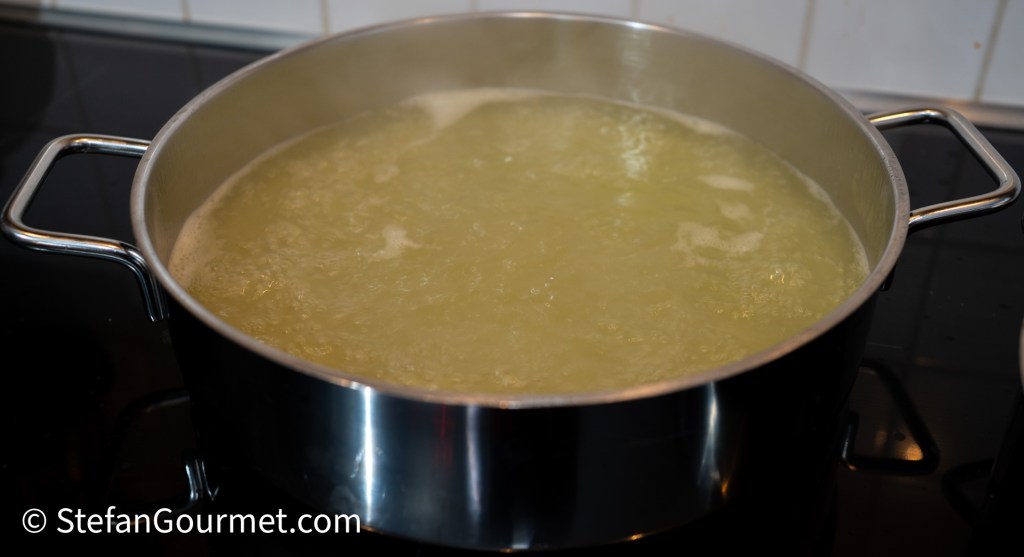
Pour the fish stock into a wide, shallow pan and bring it to a boil.
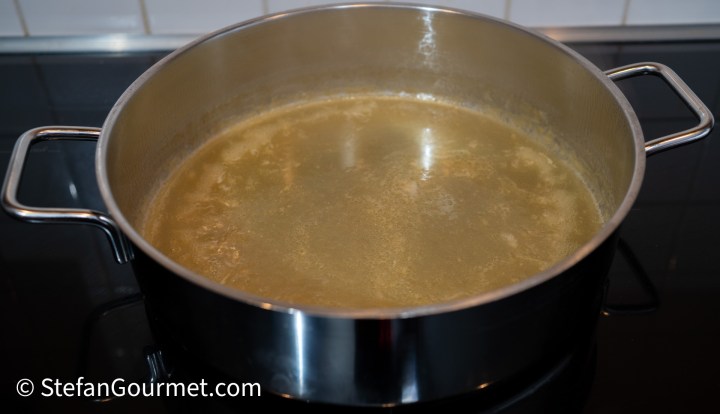
Reduce the heat and simmer until the liquid has reduced to approximately 125 ml (1/2 cup).
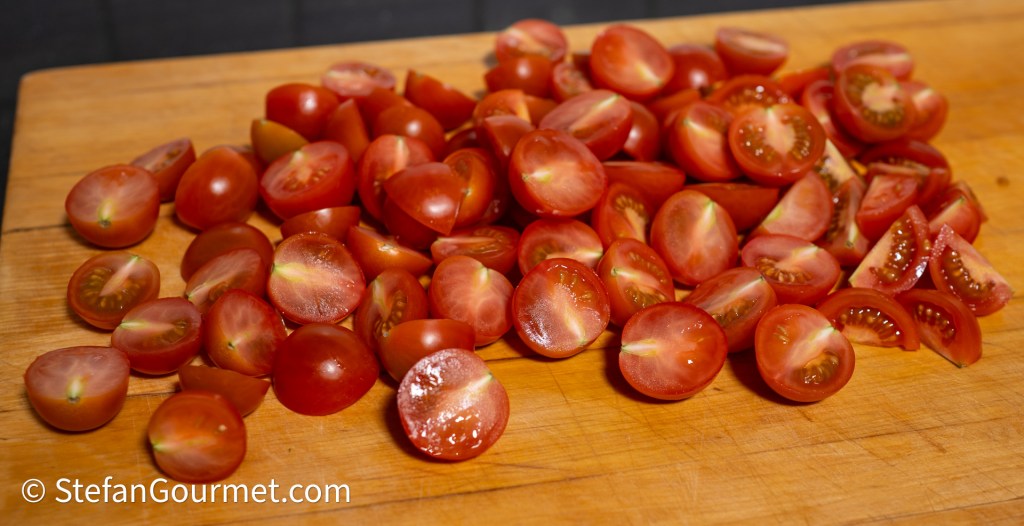
While the stock is reducing, cut the cherry tomatoes in half.

Once the stock has reduced, select a frying pan wide enough to accommodate the fish fillets in a single layer. Heat three tablespoons of olive oil and add the minced garlic.
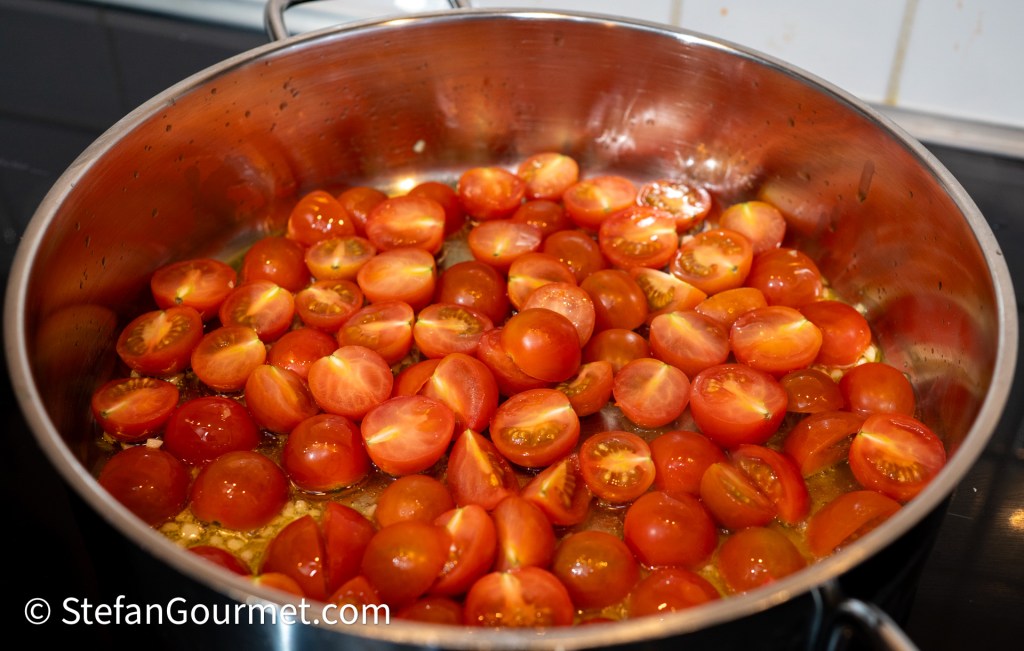
Before the garlic begins to color, add the halved cherry tomatoes and season with salt and freshly ground black pepper.

Stir briefly, then deglaze the pan with the white wine.

Bring to a boil and cook for one minute.

Then add the reduced fish stock.

Bring the liquid to a boil once more, then turn off the heat.
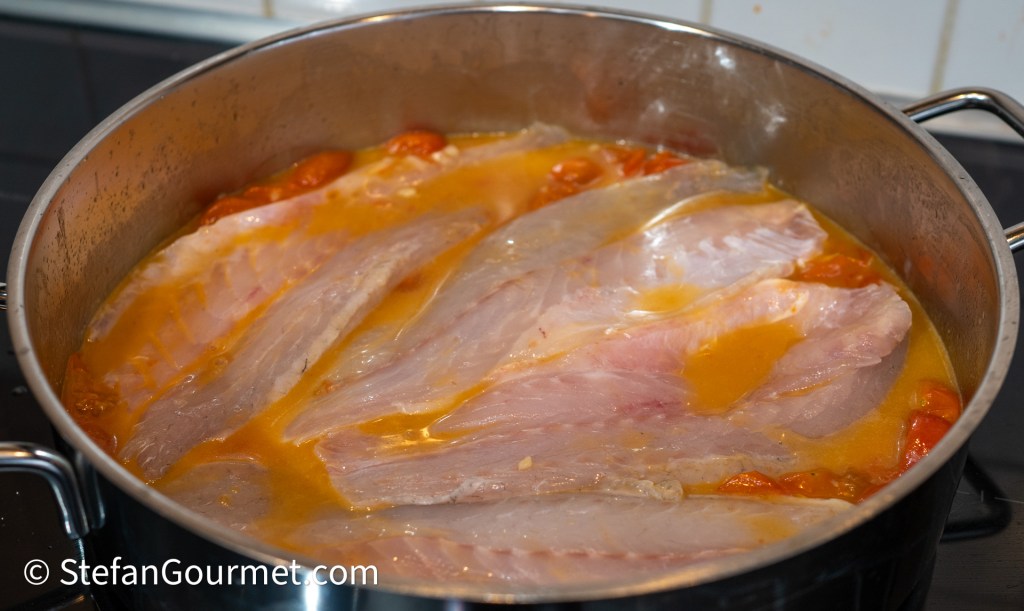
Arrange the fish fillets in the pan in a single layer. Cover the pan and allow the fish to cook in the residual heat of the sauce for three minutes.
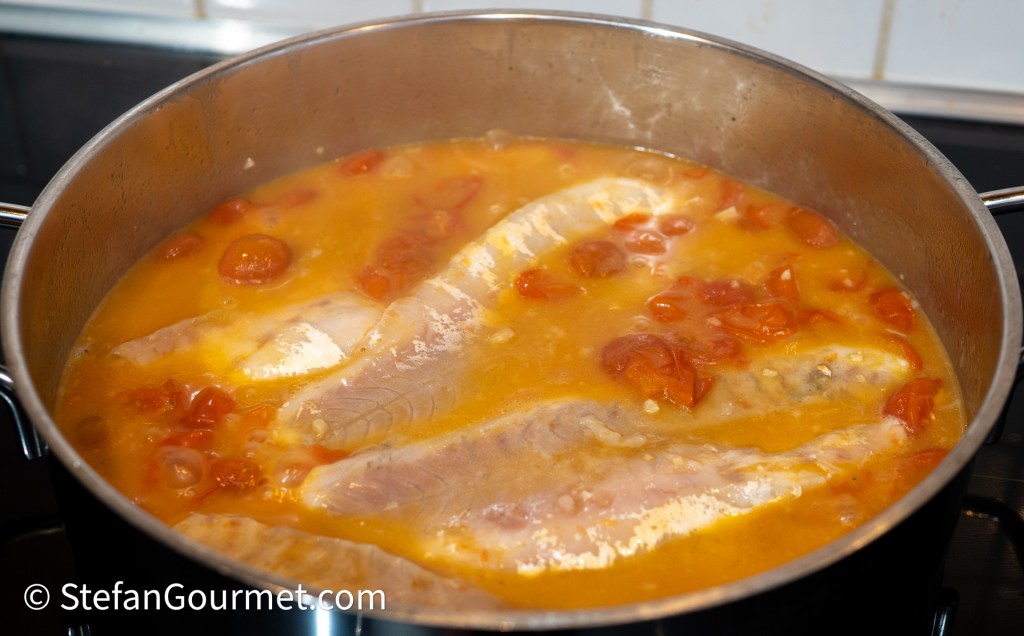
Carefully turn the fillets to avoid breaking them, cover the pan again, and let them sit for another three minutes.
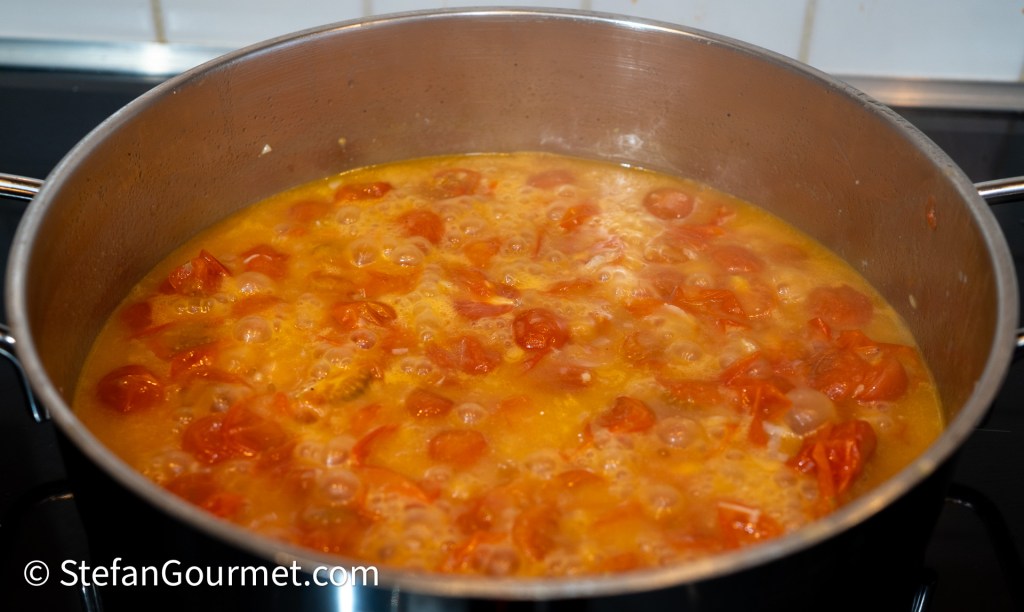
Carefully transfer each fillet to a preheated plate. Bring the remaining broth to a boil, then pour the hot liquid and tomatoes over each fillet.
Garnish with minced parsley and a drizzle of your finest extra virgin olive oil. Serve immediately, ideally with crusty Italian bread to mop up the juices—a practice the Italians call fare la scarpetta.
Wine pairing
Since this dish originates in Campania, the most natural choices for a wine pairing are a Greco di Tufo or a Fiano di Avellino. However, many other Italian white wines will work beautifully as well.


Simple, beautiful and hugely appetizing – thank you for the exact method. Methinks this would make a very special meal any day of the year. In my part of the world snapper is always available and sea bream may not be a stranger to the fishmonger . . .
LikeLiked by 1 person
Hello Stefan – here is wishing you and Kees a wonderful holiday period and I am sure you two will enjoy fabulous meals! I came across another version of this recipe by chef Andre Arpea that you might like to peruse: https://www.lacucinaitaliana.it/ricetta/spigola-acqua-pazza/. Buon Natale e buon anno nuovo!
LikeLike
Thanks Jo! It certainly is an interesting and probably delicious recipe, but to me it is a stretch to still call this acqua pazza! Best wishes for Pino and yourself as well!
LikeLike
Una delle ricette migliori per il pesce! Ne esalta il sapore. Grazie
LikeLiked by 1 person