While I was on vacation in Thailand, I received an unexpected message on Instagram from Hatsune, a Japanese restaurant in Amsterdam I had never heard of before. They reached out because they had read my articles on Yamazato and Hokkai Kitchen and enjoyed my approach. They invited me for a complimentary meal in exchange for a review on the blog and Instagram.
Initially, I hesitated. My ‘day job’ as a strategic advisor provides me with the financial independence to run this blog exactly as I please. I have always turned down paid collaborations because I value the luxury of being able to write exactly what I think without any external pressure. If they had asked for a positive review in exchange for a free meal, I would have declined immediately.
However, Hatsune’s approach was different. They didn’t demand praise; they simply asked for a review. Two factors convinced me to take them up on it. First, the benchmark: by citing my deep-dives into Yamazato and Hokkai, they knew exactly what kind of ‘nerd’ they were inviting. They weren’t looking for a typical ‘influencer’ post; they were inviting a discriminating palate. Second, the data: a quick check of their 4.8-star rating on Google suggested that the risk of a subpar experience was low. My empirical side was curious to see if the reality lived up to the digital reputation.
I want to be clear with my readers: my opinion is not for sale. I do not plan on actively soliciting free meals, and this will remain a sporadic occurrence at most. I accepted this invitation as a one-time experiment to see how a restaurant that seems to aim high performs when they know a critic is in the house. I accepted with some trepidation that my readers might think my independence had been compromised. But as you will see from the details below, my Dutch directness remains fully intact. In fact, I’ll tell you right now: the ultimate test of any review is whether I’d spend my own money there. By the end of this article, you’ll know why I already plan to return to Hatsune as a full-paying customer.
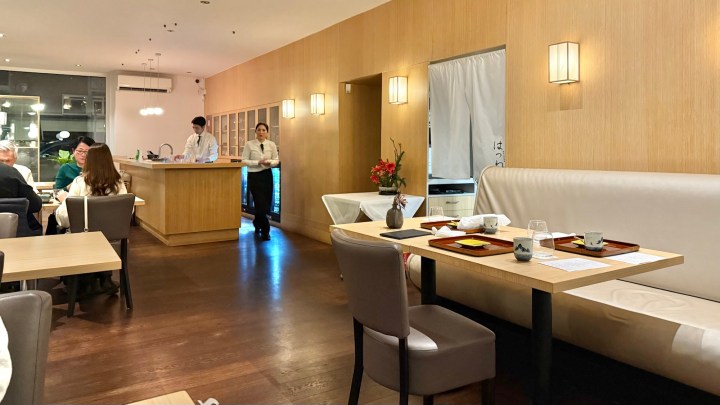
Hatsune recently opened on Beethovenstraat in Amsterdam. This location is a strategic choice; the area borders Buitenveldert and Amstelveen, where the Japanese community has been concentrated since the 1960s and 70s when major Japanese corporations established their European headquarters there.
The restaurant specializes in kaiseki and kappo cuisine, including tempura kaiseki. Kaiseki is Japanese haute cuisine—a structured multi-course meal designed to highlight the seasons through precise preparation and artistic presentation. It consists of an appetizer (Sakizuke), moving to a soup or steamed dish (Wanmono/Mushimono), followed by sashimi (Mukozuke), a fried course (Agemono), and concluding with the mandatory rice set (Shokuji) and a seasonal dessert (Mizumono). Kappo literally means to cut and to cook. It is a more direct, intimate style of dining where the chef prepares and serves each bite directly to the guest. Hatsune leans toward the kaiseki tradition, as the chef only appeared at the end of the meal, though the kappo element is clear in how the tempura is served.
Chef Mitsuhiro Narita brings a serious pedigree to the kitchen. He served as an instructor and chef at the Tsuji Culinary Institute Group in Japan and played a key role in opening Brushstroke in Tribeca, New York. That restaurant, a collaboration with David Bouley, focused on integrating traditional kaiseki with local ingredients and was awarded a Michelin star.
At Hatsune, the focus is on the natural essence of each ingredient rather than heavy seasoning or the distraction of elaborate decor and music. The interior is understated and minimalist, which feels authentically Japanese.
For dinner, the restaurant offers three set menus: Tempura Kaiseki (120 euros), Classic Kaiseki (120 euros), or Special Kaiseki (150 euros). There is no a la carte option. The sake and wine pairings are both priced at 45 euros, while a non-alcoholic pairing is available for 35 euros. Reservations are essential, as there are only six tables and the ingredients are purchased fresh every day.
I opted for the Tempura Kaiseki. I have a great affinity for tempura, and I also consider it an excellent benchmark for judging a kitchen’s technical proficiency. Serving tempura that is light and crispy rather than heavy and soggy is a feat that requires years of specialized training to perfect. The waiter suggested the sake pairing over the wine pairing, a recommendation I was happy to follow.
To get things started, a wet towel was offered to clean our hands, and a small sip of a neutral sake to clean our palate.
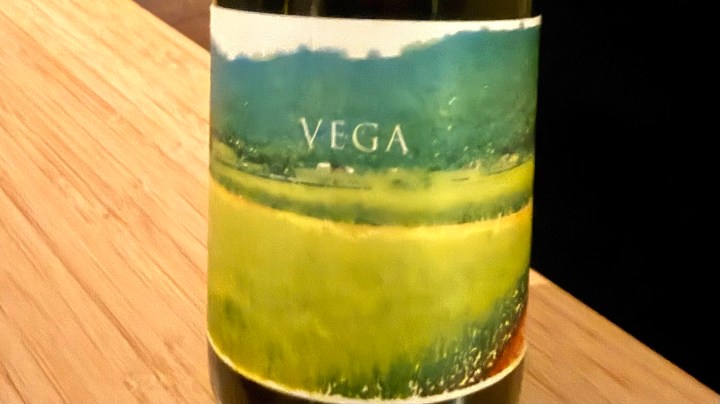
The first sake was a Vega from Abe Brewery in Niigata. This is a Junmai with a modern profile: light-bodied, low in alcohol (13%), and high in acidity. The balance between sweetness and acidity reminded me of a Mosel Riesling, making it a good choice for the first dish.
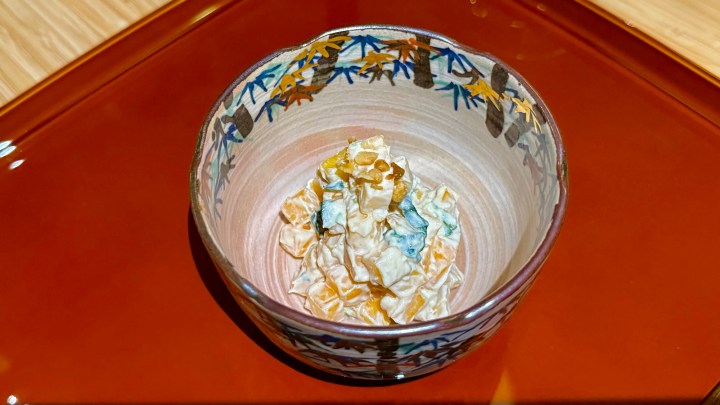
The first dish was shira-ae, a traditional seasonal salad. In this version, crunchy and slightly sweet kaki fruit (persimmon) was dressed in a creamy sauce of mashed tofu and toasted sesame, seasoned with dashi, sugar, and soy. It was an elegant combination, where the nutty, creamy dressing perfectly complemented the crunchy and slightly sweet fruit.
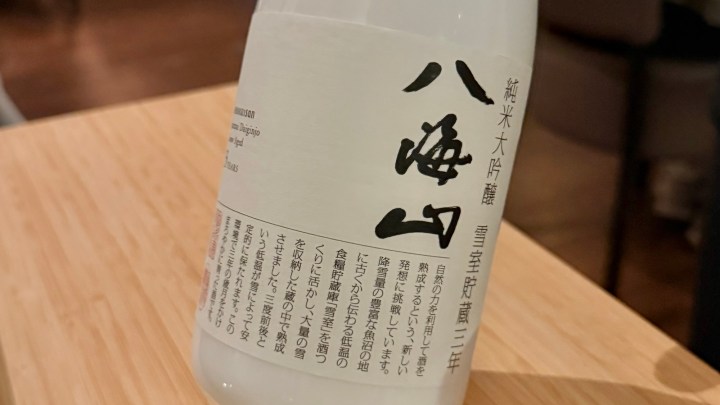
The next sake was a Hakkaisan Yukimuro Junmai Daiginjo 3 Years Snow Aged. This sake is matured for three years in a traditional snow-cooled storage room (yukimuro), which maintains a steady temperature of 3 degrees Celsius. The aging process results in a smooth and rounded profile.
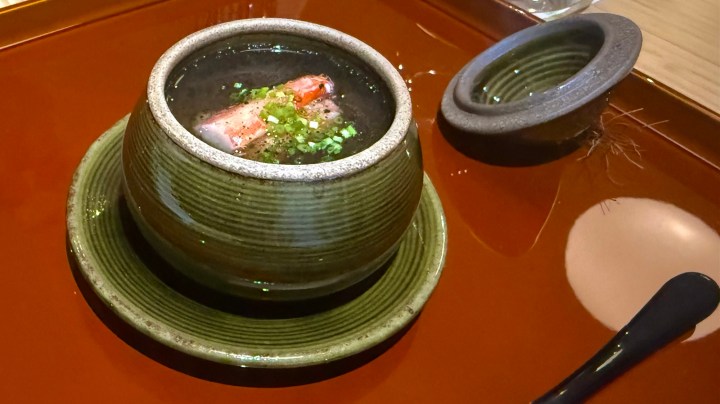
This was a good pairing for the chawanmushi with crab surimi and black truffle, the signature dish of the restaurant. Chawanmushi is a steamed savory egg custard; this version had a silky texture and a beautifully balanced, elegant flavor profile.
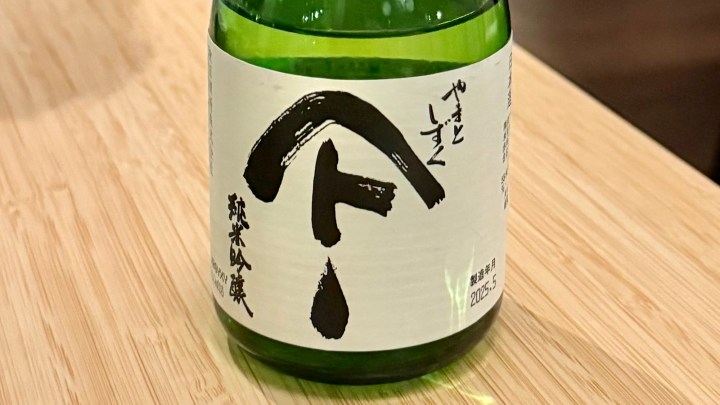
The third sake was Yamamoto Yamahai Junmai Ginjo, made using the traditional yamahai method. This technique allows for natural lactic acid development during fermentation, resulting in a more complex and earthy profile.
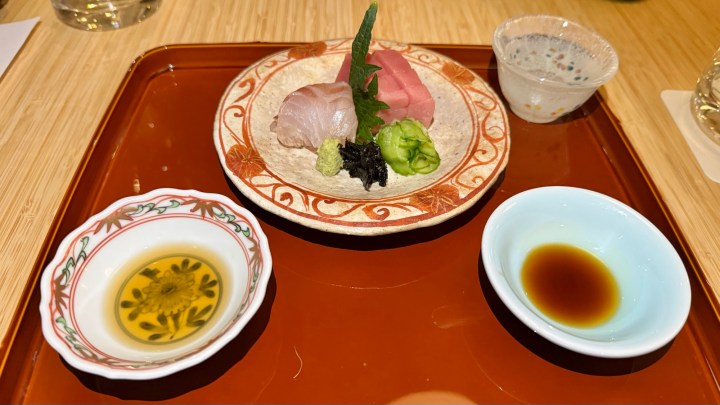
The savory depth of the sake worked well with the sashimi course of sea bream and tuna. The sea bream had been marinated between layers of kelp, and each fish was served with its own specific seasoning: soy sauce for the tuna and tosa-zu for the sea bream. Tosa-zu is a seasoned vinegar made from soy sauce, mirin, and rice vinegar infused with katsuobushi for extra umami. The tuna was sourced in Spain and I thought it was a funny detail that the sea bream was sourced from the local Albert Cuyp market in Amsterdam.
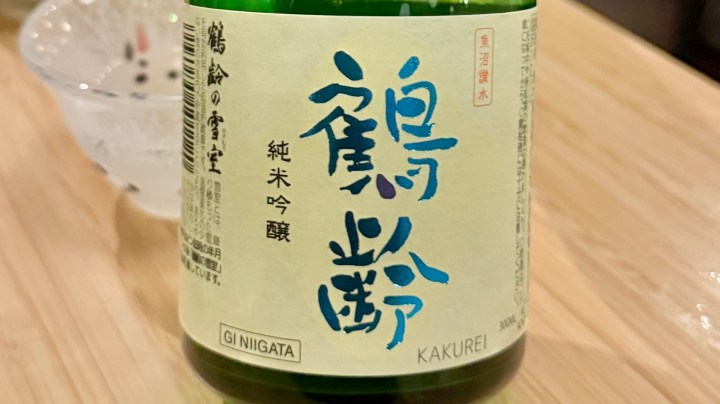
The fourth sake was Kakurei Yukimuro Junmai Ginjo from Aoki Shuzo in Niigata. Like the Hakkaisan, this sake is aged in a snow-cooled storage room (yukimuro), but it is a Junmai Ginjo rather than a Daiginjo. This maturation process creates a smooth, well-rounded character with a clean finish. It offers subtle fruit notes and a slightly richer body than the previous sakes, making it a good pairing for the tempura.
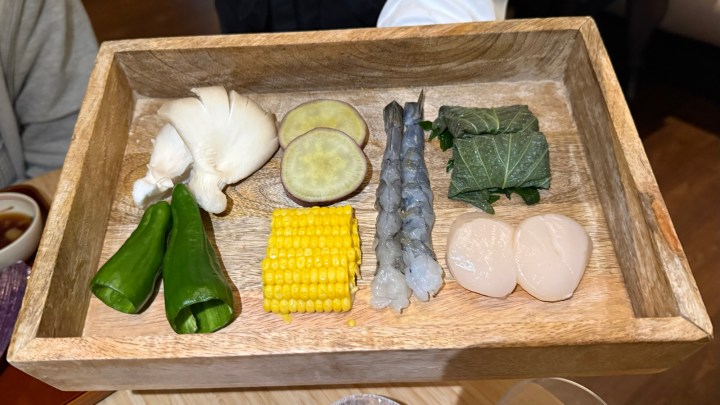
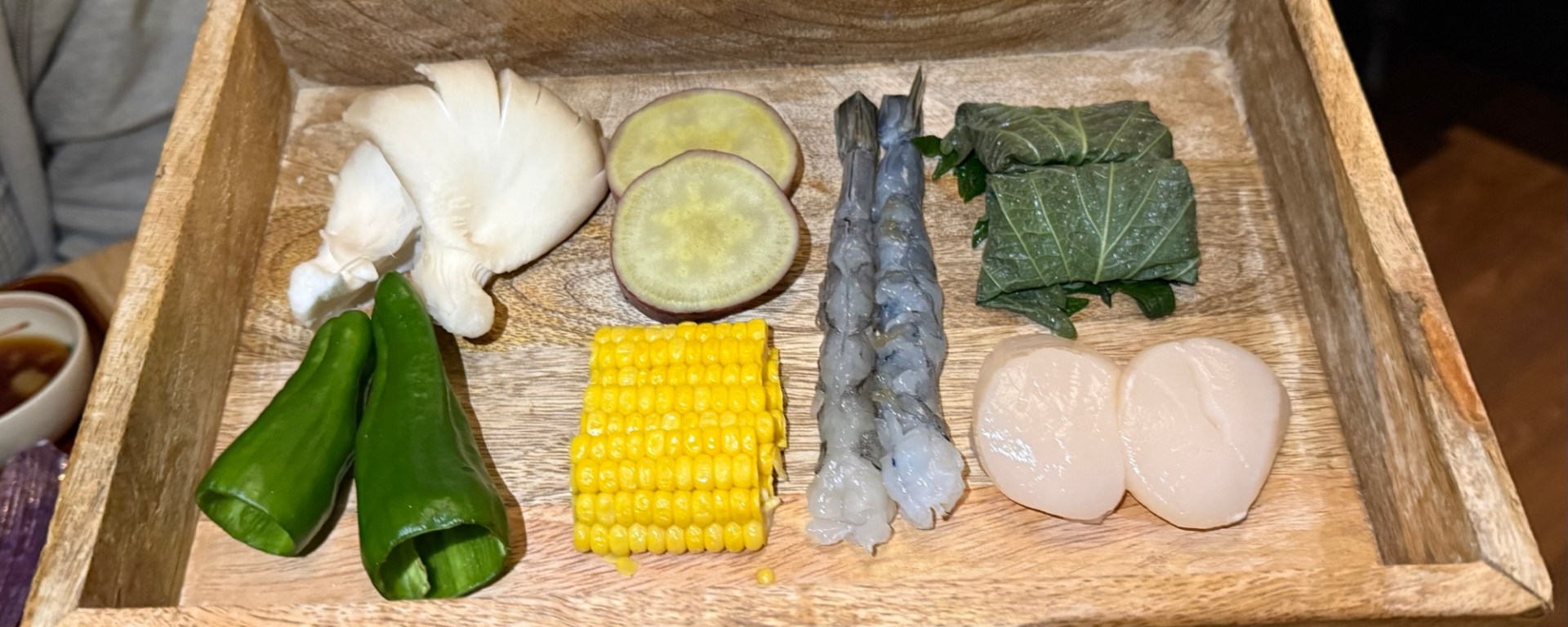
The raw ingredients for the tempura were shown and explained before being returned to the kitchen to be prepared and served one by one. Serving each piece individually ensures the perfect crispy texture and temperature are maintained, as both deteriorate quickly after frying. This paced approach also allows the guest to focus on and savor each ingredient.
The tempura was served with three seasonings to be applied to taste: a classic dipping sauce of dashi with soy sauce and grated daikon, matcha salt, and lemon salt. The waiter provided a recommended pairing for each course.

The first course was shrimp, which included both the tail and the head. All of the tempura featured a perfectly crispy, light coating that enhanced the natural flavor of the ingredients rather than overpowering them.
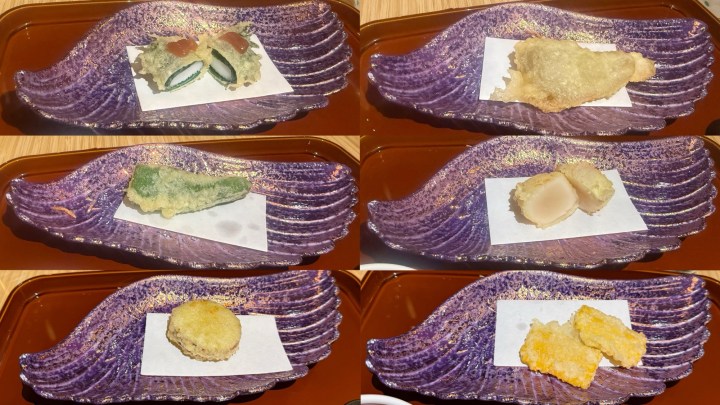
- The squid was wrapped in shiso leaf and topped with umeboshi (salted plum) sauce. The squid was remarkably tender.
- The oyster mushroom (hiratake) was perhaps the most elegant piece of them all.
- The shishito pepper was slightly spicy and very crispy.
- The Japanese scallop was perfectly cooked, remaining rare on the inside; it felt like a refined, high-end version of fish and chips.
- The sweet potato was exceptionally hot inside and required careful eating.
- A standout surprise was the corn, which had been steamed before being fried, resulting in an intense sweet flavor.
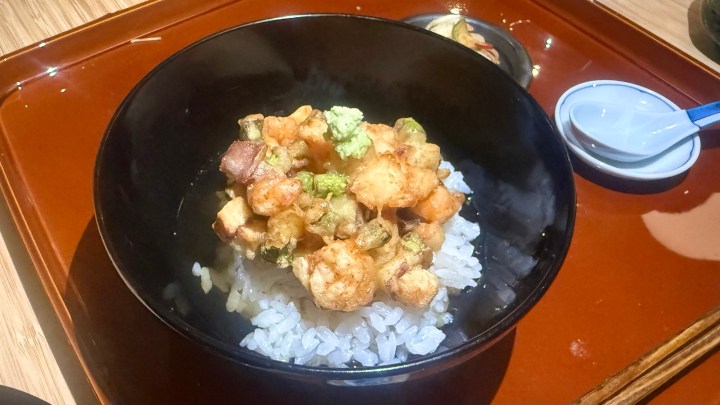
A rice course is a mandatory part of any kaiseki menu, typically consisting of rice, miso soup, and pickles. For this meal, the rice was topped with mixed tempura (kakiage). We were given the choice of having it served with a sweet soy sauce as a rice bowl or with dashi to be poured over the rice as a chazuke.
We ordered one of each to try both. I preferred the kakiage version, as the sweet soy sauce provided a more robust flavor profile compared to the more delicate dashi.
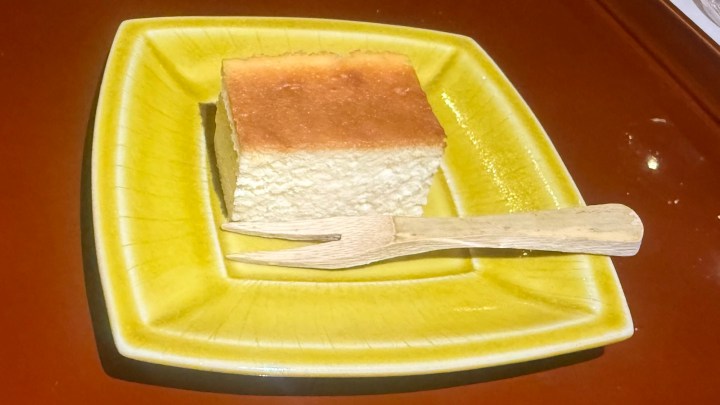
The dessert was a small serving of baked cheesecake with a light, airy texture and a delicate flavor. It came with Japanese green tea.
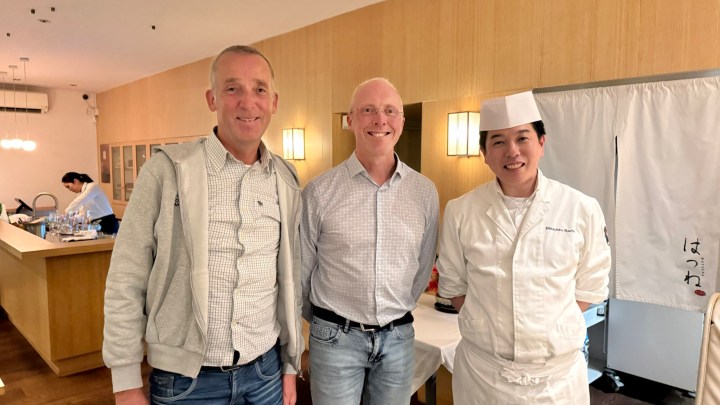
I am grateful that Hatsune invited me; it might have taken much longer to discover this restaurant otherwise. Everything about the experience felt authentically Japanese: the minimalist decor, the focus on high-quality ingredients, the precision in preparation, the traditional kaiseki menu structure, every sake being served in a unique ceramic or glass cup, every dish arriving on elaborate ceramic dishes, as well as the modest demeanor of the waiter and chef.
The detailed explanations of every ingredient, dish, and sake, made the evening feel like a masterclass in Japanese fine dining. For a food nerd, this was great. No Dutch is spoken—only English with a Japanese accent. You quickly adapt to the phonetic nuances, such as the soft “r” sounding like an “l” (turning “prum” into “plum”) or the addition of vowels between consonants (turning “snow” into “sunow”).
The pace of the meal was perfect. While serving the tempura piece by piece naturally draws out the service, it never felt slow. The entire experience lasted two and a half hours, but time flew by. Service was remarkably quick and attentive, supported by a ratio of two waiters for only six tables.
The only very minor glitches were that seasoning recommendations for two of the seven tempura courses were not automatically provided, and the paper-lined plates for the tempura were inconsistently changed. Otherwise, everything was perfect. I will gladly return to Hatsune as a paying customer and look forward to trying the special Kaiseki.


It’s 11pm on Christmas Day – I have just opened and read your post and should probably wait till the morning to write, BUT you know me . . . and the long time I have read your restaurant reviews and my many trips to Japan able to be acquainted with perchance the best there is make it hard not to speak up 🙂 !. In other words I am utterly fascinated to read your critique -and very happy you now have a Japanese restaurant of this caliber in Amsterdam. Have no comments on the sake – have drunk ‘quite’ an amount and more with enjoyment but little knowledge . . of kaiseki meals I remember many but again lack both the memory or tastebuds to more than read and learn now. Like the look of the chawanmushi and how the tempura is served . . . with apologies to you and the chef, the purplish leaf-like dishes ‘disturb’ . . . to each their own! . . . . hope you had a warm and caring Christmas Eve and both will enjoy your Christmas Day to come . . . warm wishes from Down Under where it SNOWED today in Tasmania . . .
LikeLike
I thought the purplish leaf-like dishes looked like angel wings. In the collage it does look a bit weird, but I didn’t feel like posting 7 single photos for each of the tempuras. I hope you’ve enjoyed Christmas, as Boxing Day is over where you are.
LikeLiked by 1 person
Stefan . . . to each their own. . . none of my families have ever made anything of Christmas – oft too ‘noisy’ and commercial these days . . . the time I tend to quietly disappear to ‘catch up’ with all my reading and writing 🙂 ! The purplish dishes > don’t like the colour married with food nor the gilded appearance as it comes across > angels’ wings, yes, agree 🙂 ! Be well . . .
LikeLiked by 1 person
Many thanks for the review and the recommendation! We look forward to enjoying their Kaseiki. By the way, in 2019 Akira Oshima, the chef who received a Michelin star during his time at Yamazato, and his wife opened a restaurant (Oshima) on this location. They retired a few months ago. Sweet culinary memories!
LikeLiked by 1 person
I didn’t know about Oshima and have never been. We were wondering what was at that place first, because it didn’t look all new. I look forward to hearing what you think of Hatsune.
LikeLiked by 1 person
👍
LikeLike
What an enjoyable post! Except that you made me hungry! You’re not a nerd – you’re just serious and passionate about food. I always wonder if Kees is enjoying your meals as much as you are!!! Merry Christmas!!!
LikeLiked by 2 people
Thank you and merry christmas back to you!
Kees doesn’t enjoy long meals as much as me — that’s why I have started to take five of my closest friends out to dinner for their birthdays as a win-win-win (win for Kees: he doesn’t have to come with me, win for me: I go with someone who appreciates it more and the cost for me is the same, win for my friends is obvious).
LikeLiked by 1 person