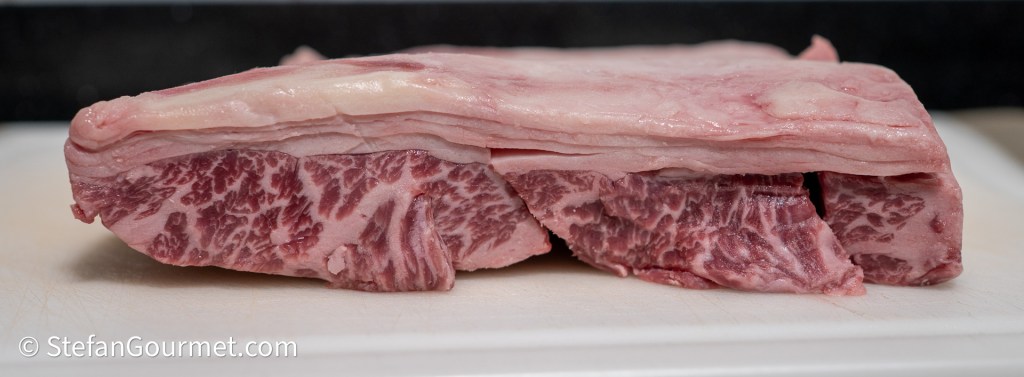
What makes Wagyu beef taste so exceptional is the intramuscular fat—the marbling that makes higher-grade steaks, such as Japanese A5, look almost completely white. Because Wagyu is expensive, it is worth seeking out cheaper cuts and using sous vide to make them as tender as steak. Short ribs are one of my favorite cuts for this, as they are among the most flavorful.
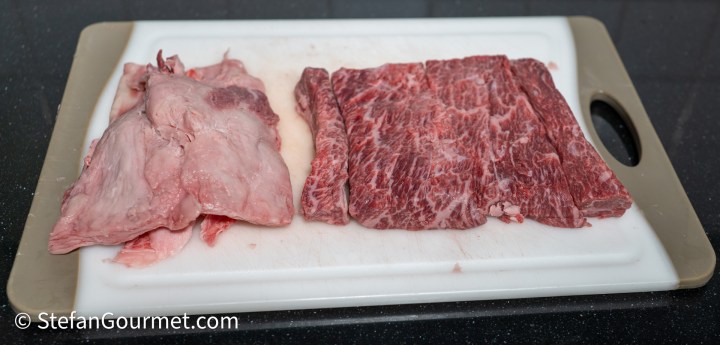
You must take the fat cap into account, however. At a local Wagyu farm, boneless short ribs sell for €65 per kilo, compared to €105 for strip steak. After trimming away the fat cap, which accounts for about 40% of the weight, the price of the short ribs is actually about the same as the strip steak.
I have noticed heated debates regarding whether it is advisable to cook Wagyu sous vide, as some claim this renders out the fat. I doubted this, but as usual, I prefer to back my claims with evidence rather than just stating an opinion. I conducted an experiment to determine once and for all whether fat renders out of Wagyu when cooked sous vide to medium-rare. Since any fat that renders out has nowhere to go but the vacuum-sealed bag, the results would be clearly visible. If there is no fat in the bag, no fat has rendered out of the meat. I used locally sourced Wagyu for this experiment, but there is no reason to expect that higher-grade Japanese A5 Wagyu would behave differently.
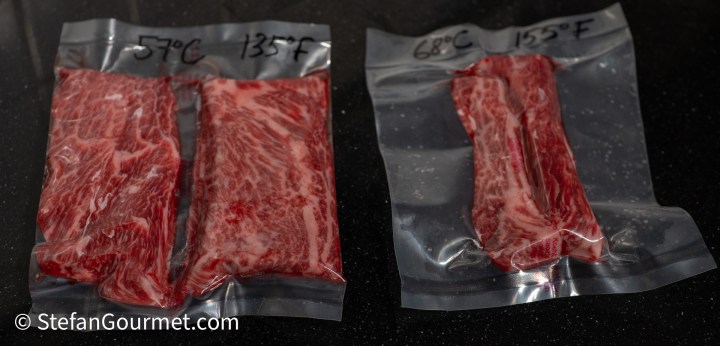
I chose 57°C/135°F as the temperature, as I know from experience that short ribs attain a steak-like texture when cooked sous vide for 48 hours at that setting. As a control, I cooked another portion for 48 hours at 68°C/155°F, which is a favorite time and temperature combination for achieving a braised texture. Because I was confident in the likely outcome, I used only a small piece for the higher temperature to avoid ruining more of the precious Wagyu than necessary. I vacuum-sealed the beef with salt only. Before the long cook, I submerged the Wagyu intended for 57°C/135°F in near-boiling water for about 10 seconds to kill any surface Lactobacillus. This is a crucial step to prevent the unpleasant, funky smell that can otherwise develop. (Read more about this here.)
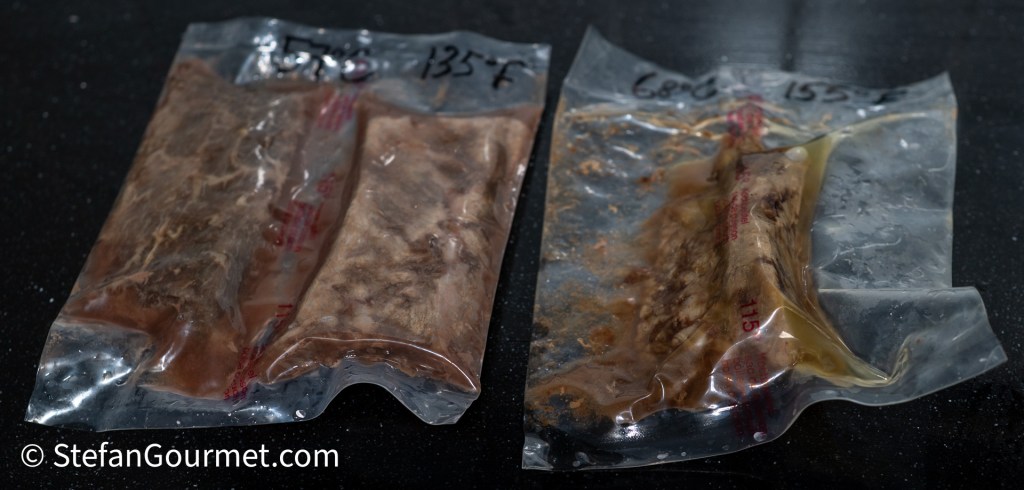
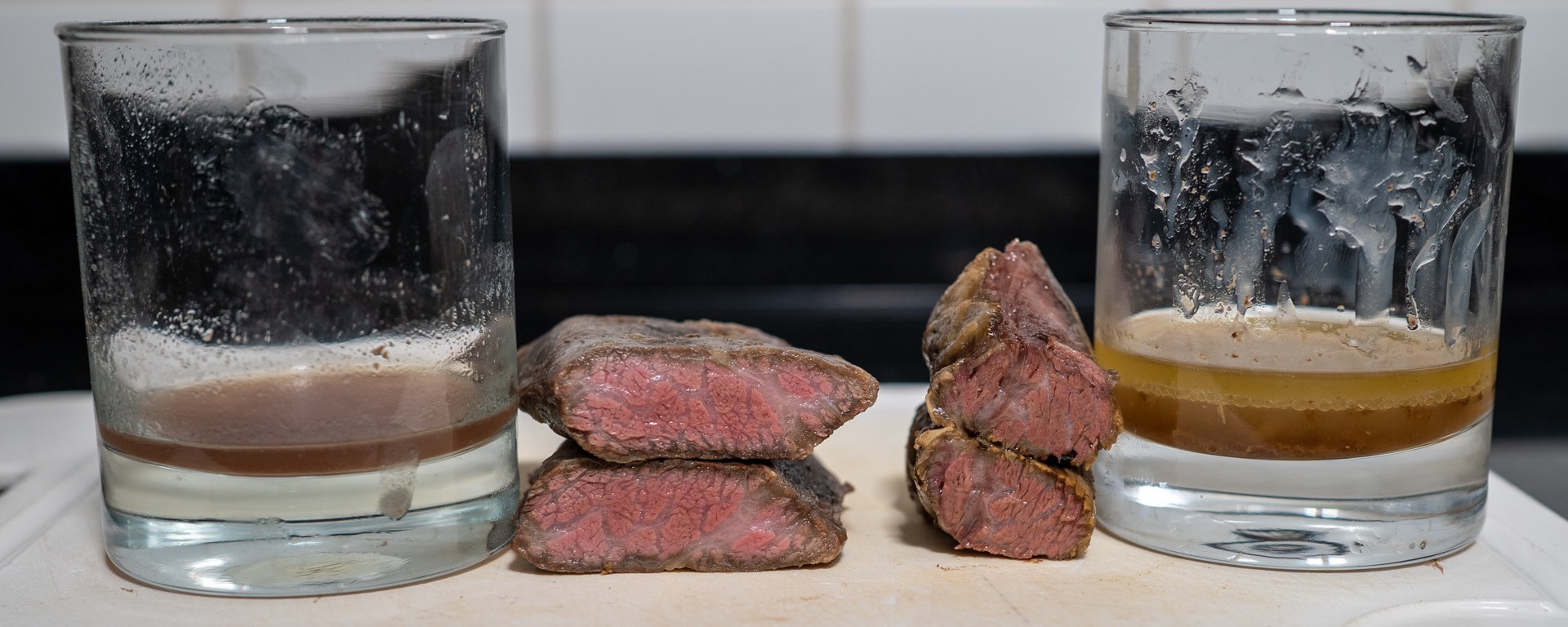
After 48 hours, it was already apparent that the Wagyu cooked at 68°C/155°F had lost significantly more juices and fat than the beef cooked at the lower temperature.
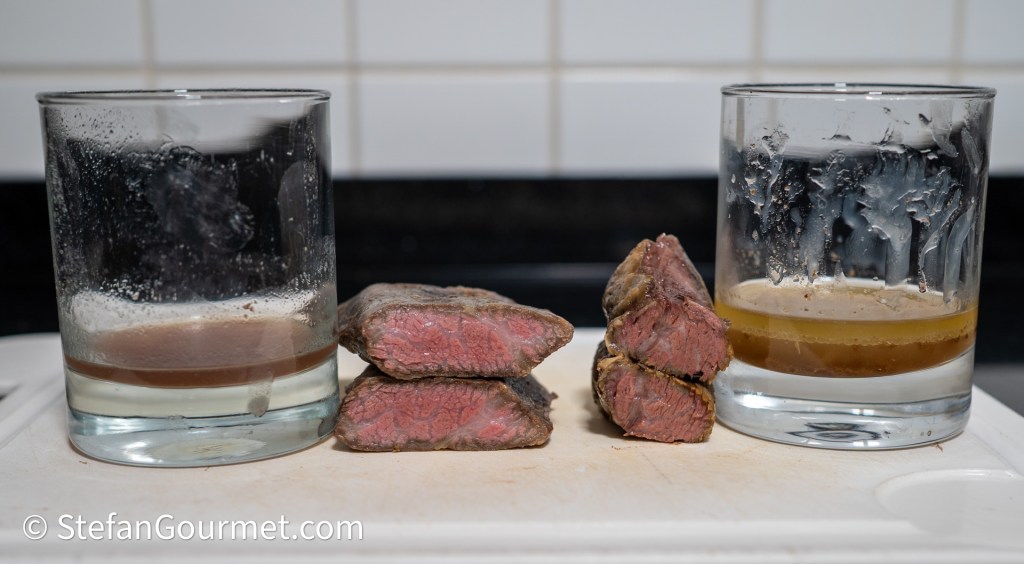
For the best comparison, I poured the juices from the bags into a clear glass and sliced through the beef to inspect the interior. There was no noticeable fat in the juices from the short ribs cooked at 57°C/135°F, proving that no fat renders out at this temperature. In contrast, a significant amount of fat rendered out at 68°C/155°F. Since you pay a premium for the intramuscular fat in Wagyu, this suggests it is not worth buying Wagyu over regular beef if you plan to braise or stew it. The difference is clearly visible in the photo.
Some people avoid cooking Wagyu steaks sous vide because a brief sear on each side in a pan or on a hot grill yields a perfect result. While there is nothing wrong with that method, the claim that sous vide should be avoided to prevent rendering out the fat is absolute nonsense, provided we are talking about cooking to medium-rare.
This misconception may stem from confusion between melting and rendering. Wagyu fat melts at 57°C/135°F, and even at much lower temperatures. However, the fat is trapped within connective tissue. At 57°C/135°F, this connective tissue slowly softens—rendering the short ribs tender over 48 hours—but it does not contract enough to squeeze out the melted fat and juices, remaining strong enough to keep the fat contained. At 68°C/155°F, the meat contracts significantly more and the connective tissue breaks down from collagen into gelatin, allowing the fat to escape.
Ultimately, cooking Wagyu short ribs sous vide for 48 hours at 57°C/135°F is a superior method. No other technique can make short ribs as tender as a ribeye steak while keeping the fat inside.
I conducted this experiment for an entry in the Sous Vide FAQ I’ve started to compile; each entry comes with an infographic.


Definitely makes sense, Stefan. These lower temperatures would almost never render out the beef fat significantly. I like the short ribs cooked even longer (72 hours) at 140F after removing the bone and have posted about it. Fat is not rendered out and the meat is wonderfully tender. I use regular “prime” US beef for that, but Wagyu would behave similarly I would think.
LikeLiked by 2 people
An absolutely fascinating ‘read’ and learning experience. Thank you.
LikeLiked by 1 person
There is also something interesting going on here linguistically, as in Dutch we don’t really have different words for “rendering” and “melting”. According to chat, in Estonian this distinction does exist: rasva sulatama versus sulama. In Dutch this “melting out” versus “melting”, so nit really a distinction in the word.
LikeLiked by 2 people
Stefan – thank you 🙂 ! I was not really aware that there is a difference – I know the verb as ‘sulatama’ BUT thinking, thinking, thinking (am just having morning coffee after being up half the night watching the Olympics from ‘my side’ of the world!) yep, ‘sulama’ is ‘there’ and making sense. OMG (sorry!) – a Dutchman teaching me my birth language – laughing and sending you an unasked-for hug !!! One you make happen and the other happens!
LikeLiked by 2 people
This is fascinating! Thank you!
LikeLiked by 2 people