
As a holder of a Dutch level 4 diploma in wine (vinoloog in Dutch), one of the questions I get asked most often is what my favorite wine is. Although I’m generally a lover of Italian wine, my favorite white wine is French: white Burgundy from Meursault, Puligny-Montrachet, Chassagne-Montrachet, and preferably Montrachet Grand Cru. However, my favorite red wine is Italian: Barolo.
This love affair started about 20 years ago. I had just begun to enjoy drinking wine, and we were having a company retreat at a conference hotel with a pretty good wine list. The waiter was about to bring out the house red, but the executive vice president who headed our meeting took one look at the bottle and asked for the wine list. He then picked a Barolo. Unfortunately, I don’t remember the producer, but I do remember that it was excellent with the filet mignon we had for dinner and that it was by far the best red wine I had ever tasted.
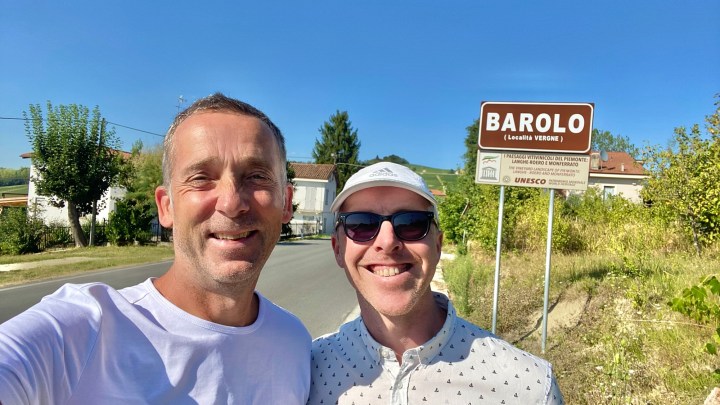
Barolo is called the king of wines—and a wine for kings. It has high acidity and hefty tannins, so it’s not an easy wine to love. It must be enjoyed at the right age and with the right food. Some producers extract so much tannin that by the time the tannins have softened, there’s not much left to enjoy. But when it all comes together, Barolo is wonderful: powerful yet elegant, with captivating aromas of roses and violets.
Barolo is made from the Nebbiolo grape, a variety with thick skins and small berries but little color. One of the things that makes Nebbiolo wines stand out is their combination of high tannins and light color—whereas most grape varieties with high tannin, such as Cabernet Sauvignon, Malbec, or Tannat, produce deeply colored wines. What makes Barolo special is that Piemonte in Italy (and a small area in Lombardia called Valtellina) is the only region where world-class wines are produced from Nebbiolo. This is very different from other grape varieties used for the best wines in the world, like Chardonnay, Cabernet Sauvignon, and Pinot Noir, which thrive not only in their classic regions (Bourgogne and Bordeaux in France) but also in places like California and Australia. Some Nebbiolo wines are produced outside Italy, but they don’t come anywhere near Barolo. You can read more about the Barolo appellation here.
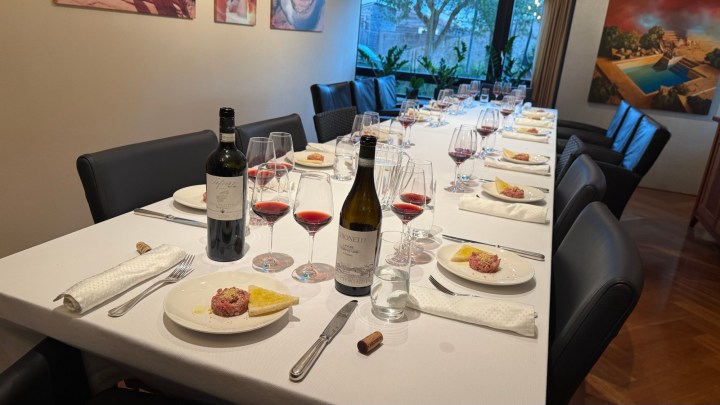
Hosting wine pairing dinners has been a long-time tradition for me, starting back in 2010. Since then, I have hosted three or four six-course dinners with the same theme every fall and another three or four with a different theme every spring. Each dinner hosts between 12 and 16 people. Each course is paired with two different wines, using just one bottle of each type to provide a sampling-sized pour of each. While the menu remains the same for all dinners within a season, I change the wines to keep the experience interesting for myself as well.
Because Barolo needs to be aged for several years before it can be enjoyed—and because I like it so much—I have a pretty substantial collection in one of my wine fridges: over 200 bottles of Barolo and its neighbors Barbaresco and Roero. I thought it would be wonderful to share this collection with family and friends by choosing Nebbiolo as the theme for the fall of 2025. I’ll tell you all about those dinners later, but for now I’d like to point out something that struck me: some of my friends at those dinners, who also hold a Dutch level 4 diploma in wine, mentioned that they don’t understand why Barolo is my favorite wine. They don’t care for it very much. Yet they enjoyed the Barolos at my dinner more than they had expected—probably because of the age and the food pairing. As even wine connoisseurs like them don’t always know how to enjoy Barolo, I decided to write this article.
Before I go into aging, pairing, serving, and a description of the Nebbiolo dinners at my house, let me explain a little about the different styles of Barolo. This is a very complicated topic, so I’ll just cover the basics.
Styles of Barolo
First of all, terroir. The area where Barolo DOCG is allowed to be produced is subdivided into 11 communes, further divided into 170 different Menzioni Geografiche Aggiuntive (MGA). Each of these has different characteristics in terms of soil, altitude, exposition, and aspect (steepness). Because it would be too much detail to go into the differences within Barolo, I will compare Barolo DOCG with the other Nebbiolo appellations—Barbaresco DOCG and Roero DOCG—to illustrate the differences.
Soil: Sandy soil produces more elegant wines, clay more robust wines. Barolo has more clay, whereas Barbaresco and Roero have more sand; hence the wines from those areas are generally lighter in style than Barolo. Such differences also exist within Barolo, for example the communes La Morra and Verduno produce more elegant wines (also because they have more calcareous soils) than Serralunga and Monforte.
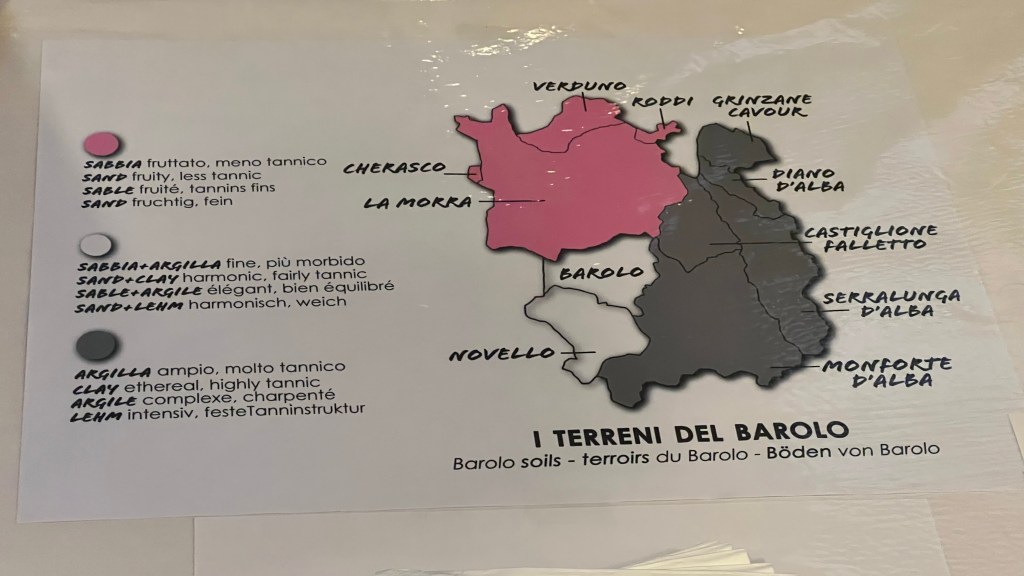
Altitude: Higher altitude means lower temperature and thus higher acidity.
Exposition and aspect: A southern exposition on a steep slope means more concentrated sunlight, leading to higher alcohol and thicker skins, and thus more body in the wines. Barolo generally has steeper vineyards than Barbaresco and especially Roero, so the wines have more body.
The style is also impacted by the vintage. Warmer years tend to produce riper grapes with softer acidity and higher alcohol, giving the wines more body and roundness. Cooler years preserve acidity and freshness, often resulting in more elegant, structured Barolos. Sunlight plays a key role too: abundant sunshine thickens grape skins, increasing tannins and concentration. Rainfall matters because too much rain can dilute flavors, while dry conditions concentrate the grapes, leading to more intense wines.
The other important factor that determines the style of Barolo, apart from terroir and vintage, is the winemaking. I’ll cover two topics: extraction and aging. Traditionally, Barolo is made using heavy extraction of color and tannins, caused by high fermentation temperatures, long maceration times, and techniques that increase contact between the fermenting wine and the skins, such as punching down or pumping over. All of these techniques give the wine more longevity, but they also result in high tannins that can take a long time to soften. More modern techniques include lower fermentation temperatures, shorter maceration times, and gentler methods of extraction, producing wines that are fruitier and more approachable in their youth, with often less longevity.
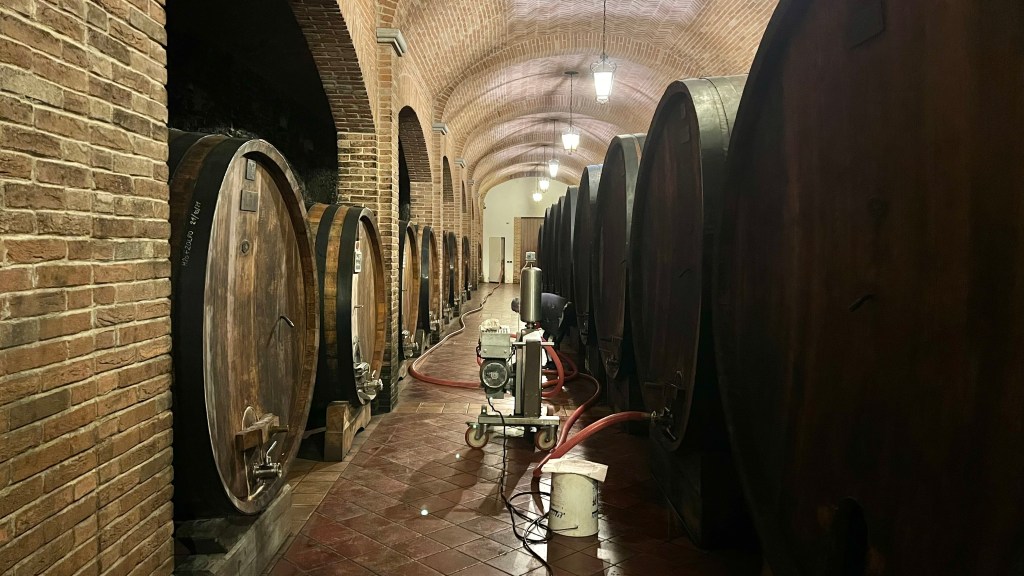
Traditional aging takes place in large oak barrels, which expose the wines to some oxygen to help soften the tannins, but not as much as smaller barrels, and they do not impart any flavors like you would get from new oak (such as vanilla and toast). The long aging in oak is needed to soften the tannins, which is why Barolo DOCG must be aged for at least 38 months, with a minimum of 18 months in wood, before it may be released to the market. This is why Barolo 2022 has only been released in January 2026. Barolo Riserva requires even longer aging—62 months, of which 18 in barrel (usually the time in barrel is longer, to distinguish the riserva from the regular Barolo, which also has a minimum of 18 months in barrel). Modern production methods use smaller barrels like French oak barriques, sometimes even a percentage of new oak. To traditional Barolo producers, new oak is sacrilege, as the vanilla could easily overpower the floral aromas for which Barolo is famous. Most modern producers have moved back to a hybrid approach that uses both small and large barrels. If you found all of this too complicated, the thing to remember is that traditional Barolo has more tannin and needs a long time in the bottle before it is ready to drink, whereas modern Barolo is fruitier and can be enjoyed much sooner.
Aging Barolo
One of the most difficult aspects of enjoying Barolo is knowing when a bottle is ready to drink. The challenge lies in the fact that the optimum drinking window can be anywhere from 6 to 20 years or more, depending on the style and the vintage. If you have only a single bottle, I recommend finding out as much as you can about the producer’s style and the character of the vintage. For a modern style from a “light” vintage (cooler, rainier conditions), your best bet is to drink it between 6 and 8 years after the vintage. For a traditional style from a “heavy” vintage (warm and dry), the ideal window is more likely between 15 and 20 years. If you know nothing about the wine’s style or the vintage, a safe choice is between 8 and 12 years after the vintage.
If you have several bottles, try your first one after 6–12 years, depending on the producer’s style and the vintage. If the wine shows very harsh tannins and the aroma seems closed, you’ll know to wait another 4–6 years before opening the next bottle. On the other hand, if the wine is approachable and has a wonderful aroma, it may be wise to drink the remaining bottles within the next few years — unless, of course, you enjoy very old wines with their characteristic aging (tertiary) notes such as forest floor, earth, and wet leaves. Sometimes a winemaker extracts so much tannin that, by the time the tannins have finally softened, only those tertiary aromas remain and the wine seems “dried out”.
I’ve noticed that many restaurants feature only, or mostly, the latest‑release Barolos on their wine lists or in their wine pairings, which often results in what I would call “baby murder”: opening these wines far too young. Only some modern styles can be enjoyed immediately after release, and even those usually improve with a few years of bottle age. To summarize in one sentence: do not drink Barolo too young!
As for the aging itself, the ideal conditions are straightforward. The temperature should be cool and constant, between 10 °C/50 °F and 15 °C/59 °F. Bottles should be stored on their side so the cork remains moistened by the wine and does not dry out. Keep them in the dark or at least shielded from UV light, and away from vibrations. If you have a cellar or a wine fridge, achieving these conditions is easy. If not, keep in mind that any deviation from these guidelines becomes more damaging the longer the wine is exposed. A bottle won’t be ruined by a few days at, say, 25 °C/77 °F or by the vibrations of transport. But because Barolo often needs to be stored for five years or longer, successful aging requires a place that is at least dark and has a temperature as constant and as close to the ideal range as possible. Around 20 °C/72 °F is not a disaster, but the wine will age more quickly. For that reason, storing Barolo in a wine rack in your living room is usually a bad idea—unless it is an empty bottle kept as a memento.
Pairing Barolo with Food
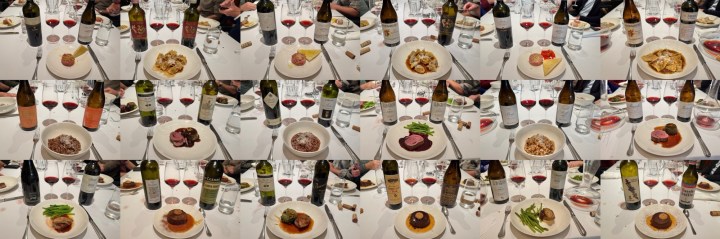
Barolo is a food wine. Even when properly aged, its tannins can still be a bit harsh when enjoyed by itself. The difference between tasting a Barolo on its own and tasting it after a bite of beef with a red wine sauce can be worlds apart: from astringent, closed, and simple to mouth‑coating, aromatic, and complex. It is therefore important to enjoy Barolo with food, but its characteristics mean that it cannot be just any food. The most problematic wines to pair are those with high levels of bitterness and astringency, combined with high acidity, high alcohol, and complex flavors — which is essentially the definition of a typical Barolo, whose alcohol level nowadays is often 14% or higher. This means the food must be selected with care. Sweetness, bitterness, and chilli heat in a dish should be avoided, as they increase the perception of astringency in the wine. Salt and acidity in the food, on the other hand, decrease the perception of astringency, bitterness, and acidity in the wine, which is what you should look for. Flavor intensity is also an important factor, as many Barolos are strongly flavored and require dishes with robust flavors. For dishes with more delicate flavors, it may be better to choose a Barbaresco or Roero, or a wine with more age. Many dishes with red meat, such as beef or venison, work very well with Barolo. I give examples in the description of the wine‑pairing dinner below.
Serving Barolo
Like all full‑bodied red wines, Barolo should be served at cool room temperature, ideally between 16 °C/60 °F and 18 °C/64 °F. Serving it cooler will make the tannins seem more astringent, while serving it above 20 °C/72 °F will make the wine feel less fresh and more alcoholic. If you don’t have a wine fridge, placing the bottle in the refrigerator for a short time can help bring it to the right temperature.
Aerating and decanting Barolo are closely related but distinct topics that often spark debate. When opening a bottle, you must decide whether to decant it and whether to aerate it as well, which starts with decanting.
Decanting is primarily about separating the wine from deposit formed during aging as tannins cluster together through polymerization. While this process makes the wine more approachable, the resulting sediment is unpleasant and even more astringent than the tannins before polymerization. To manage this, stand your bottle upright for at least a day before opening so the sediment can settle. There is an instrument called a decanting basket that you can use to keep the bottle almost horizontal while opening and pouring it, which works if you transfer the bottle out of its horizontal long-time storage to that basket without turning it, but I have never used one myself so I can’t tell you how easy it is to avoid getting deposit in your glass by using it.
The amount of deposit in a bottle of Barolo can vary greatly from hardly anything to a lot, depending on how thoroughly the winemaker filtered the wine and the age; the older the wine, the more deposit. If you haven’t tried a bottle of the same wine recently, it is safest to assume there will be deposit and handle the bottle accordingly. Serving directly from the bottle risks pouring deposit into the glasses by the time as much as 1/4 of the wine is still left in the bottle. To avoid this, you can decant the wine by pouring it into a carafe as carefully as possible, checking with a light—used to be a candle but nowadays a cell phone is perfect—to make sure you stop pouring as soon as you spot any deposit. Pouring carefully is important not only to avoid stirring up the deposit but also to avoid aerating the wine if you don’t want that to happen.
Aerating, or letting the wine breathe by exposing it to oxygen, is a more controversial topic. This can open up the aromas, but it can also quickly destroy delicate ones. This makes it a difficult decision. Some people like to enjoy a bottle over several days to see how it develops as it slowly aerates. The wine can seem closed at first and open up with air, or start with a nice aroma but close after 10 minutes or so, only to reopen hours or even a day later. However, as Barolo is best enjoyed with food, you want it to be in its prime when you serve the dish.
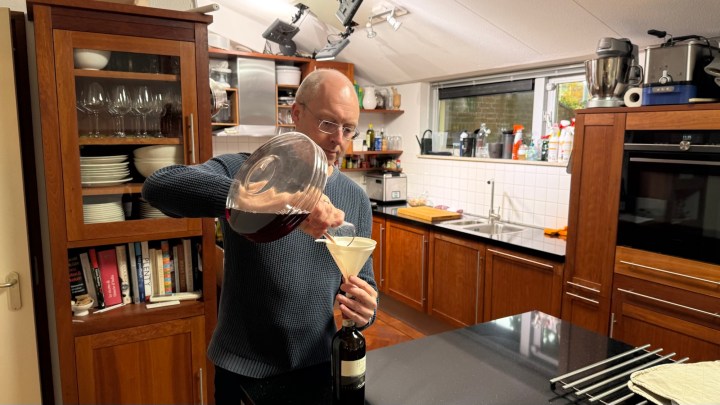
In my experience, the following approach is the best bet if you haven’t recently tried a bottle of the same wine and vintage and have no way of knowing how much aeration is needed. Decant the bottle carefully a few hours before you are serving the food, then swirl the decanter slightly and sniff the aroma. If it already smells great, leave the decanter undisturbed and perhaps even close it off, for example with plastic wrap, to limit the oxygen exposure. If you hardly smell anything, it depends on when you plan to serve the wine. If it is soon, swirl the decanter actively or even consider rinsing out the bottle and transferring the wine back to the bottle using a funnel, then pouring it into the decanter again so that maximum aeration occurs. This means pouring the wine against the inside of the decanter so a thin veil of wine flows down. You could even use a blender for hyper aeration, with the added advantage of letting your guests think you are crazy when they see you do it.
If you have time to wait, 2 to 4 hours in the decanter works very well in most cases. If you’ve made it this far, you are probably thinking that getting a Barolo to shine can be quite elusive. You would be right, because it can be tricky to pick the right number of years after the vintage to open the bottle and the right number of hours to let it aerate. But it is not like all the planets have to be aligned perfectly, as there is a lot of room for error to get a good result. Sometimes a wine is great when you just pour it and then fades, and sometimes it is at its best with the last sip. This happens and is part of what makes drinking Barolo a bit of an adventure.
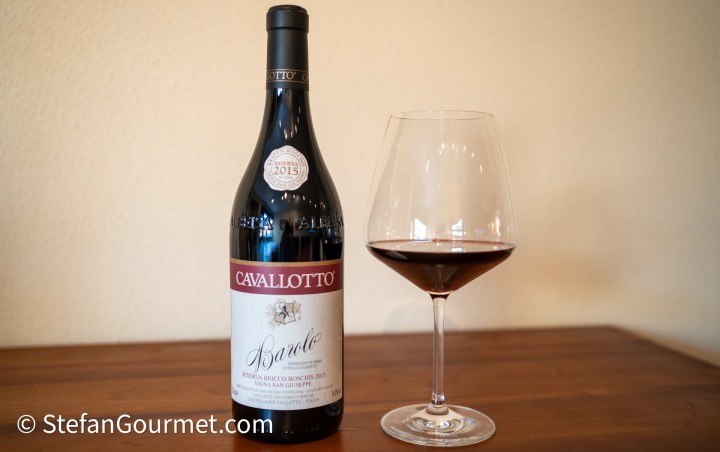
All wine should be served in a tulip-shaped glass to allow for swirling without spilling and to promote the release of aromas through a wide surface at the bottom, while concentrating those aromas toward your nose due to the narrow top. As long as wine glasses have a stem, are thin, and meet the requirement of a tulip shape, I don’t believe the exact shape of the glass is extremely important.
As the elegance and complexity of Barolo are the key characteristics to enjoy, the best type of glass is a very large and wide one, like a glass for Burgundy. Glasses designed especially for Barolo have a similar shape but are flatter at the bottom. Personally, I just use my Schott Zwiesel “Taste” Burgundy glasses, which have an astounding capacity of 782 ml (i.e. they could contain more than a whole bottle in a single glass).
Six course dinner with 13 different Nebbiolos
As I mentioned in the introduction, I had chosen Nebbiolo as the theme for the wine pairing dinners for friends and family at my house in the fall of 2025. Although Barolo and Barbaresco are the most famous expressions of this grape, some producers also craft a traditional method sparkling Nebbiolo, in both white and rosé styles, as well as a sweet aromatized version called Barolo Chinato that pairs beautifully with chocolate desserts.
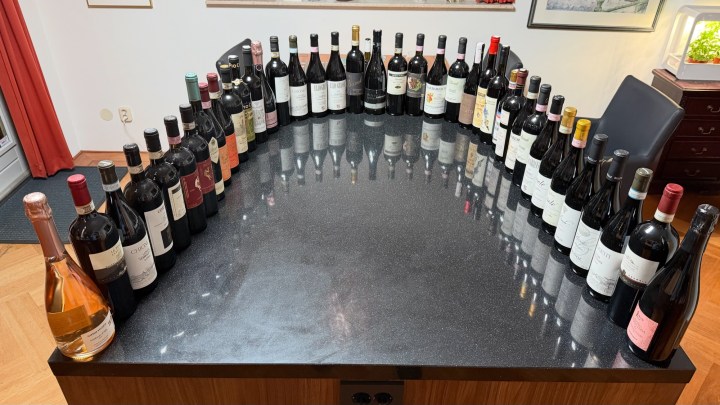
Consequently, all 13 wines—one sparkling as an aperitif, followed by six courses with two wines each—were 100% Nebbiolo. I selected dishes primarily from Piemonte that I knew would complement the grape, allowing the wines to shine. The photo shows the 39 bottles used across the three dinners. Because I don’t own twelve decanters, I opened and decanted the bottles in the afternoon before pouring them back into their original bottles using a funnel. This double-decanting approach seemed to work well for all the wines, providing necessary aeration while allowing me to serve from the bottle. Given the sampling-sized 50 ml pours, I used smaller tulip-shaped glasses to ensure the aromas were still properly concentrated for my guests.
The sparkling wines I served were:
- Negro Angelo – Negro Maria Elisa Rosè Metodo Classico Nebbiolo D’Alba Extra Brut 2021
- Cascina Chicco – Cuvée Zero Rosé metodo classico extra brut
- Sara Vezza, Nebbiolo d’Alba Spumante Brut Rosé Metodo Classico 2019
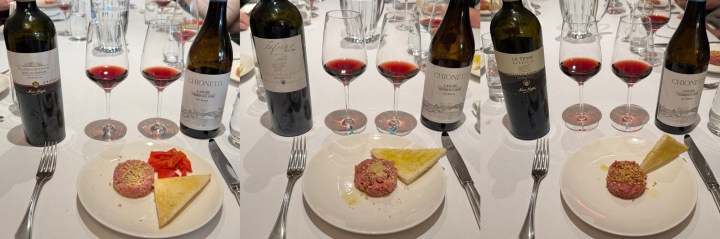
The first course was carne cruda (veal tartare) with hazelnuts, paired with the lightest versions of Nebbiolo in my collection: Langhe Nebbiolo and Valtellina. I served the same Langhe Nebbiolo each time, from the Dogliani-based producer Chionetti, though it was slightly too powerful for this dish. I didn’t aerate it the first time but did the other two times, which brought out a beautiful aroma of cherries. The Valtellina wines were three different ‘comunes’ from Nino Negri. While all the wines were good pairings, the Sassella was the lightest and therefore the best match.
- Nino Negri, Grumello Sassorosso Valtellina Superiore DOCG 2018
- Chionetti, La Chiusa Langhe Nebbiolo DOC 2018
- Nino Negri, Inferno Valtellina Superiore DOCG2017
- Chionetti, La Chiusa Langhe Nebbiolo DOC 2018
- Nino Negri, Le Tense Sassella Valtellina Superiore DOCG 2018
- Chionetti, La Chiusa Langhe Nebbiolo DOC 2018
For the Barolo, Barbaresco, Roero, and Ghemme, I opted for vertical or horizontal pairs. A vertical pair features the same wine from two different vintages, which is the best way to show how the weather of a specific year influences the final result. A horizontal pair consists of two different wines from the same vintage, allowing you to discern the differences between terroirs—such as the elegance of La Morra versus the power of Serralunga—and individual winemaking styles.
The 24 bottles of Barolo, Barbaresco, Roero, and Ghemme were all from between 2004 and 2013 (with one exception from 2016), and almost all of them were in their prime drinking window in 2025, i.e., between 12 and 21 years after the vintage. This is proof that you shouldn’t drink your Barolo when it’s too young.
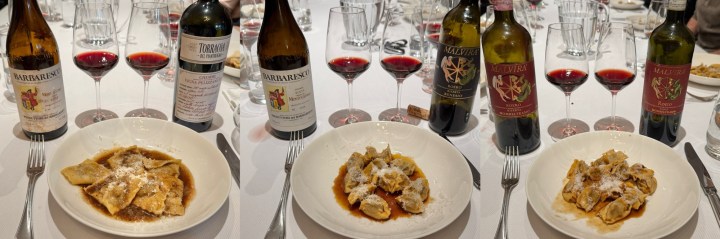
The second course was Agnolotti al sugo d’arrosto, a typical type of meat-filled ravioli from Piemonte, served with a meat jus. The ravioli were quite elegant, and I paired this successfully with Roero and Barbaresco wines, which were slightly lighter than the Barolos used for the subsequent courses.
- Produttori del Barbaresco, Barbaresco Montestefano Riserva DOCG 2011
- Torraccia del Piantavigna, Vigna Pelizzane Ghemme DOCG 2011
- Produttori del Barbaresco, Barbaresco Montestefano Riserva DOCG 2005
- Malvirà, Renesio Roero Riserva DOCG 2005
- Malvirà, Mombeltramo Roero Riserva DOCG 2006 & 2011
Produttori Montestefano 2005 was mostly tertiary at this point (2025). The Malvirà Renesio Roero Riserva 2005 however, seemed to be at its peak and still quite vibrant. In the vertical pairs of Malvirà Roero Mombeltramo 06 & 11, I noticed that the 06 had more extraction than the 11. So the difference between the vintages seemed more a difference in winemaking than a difference in weather.
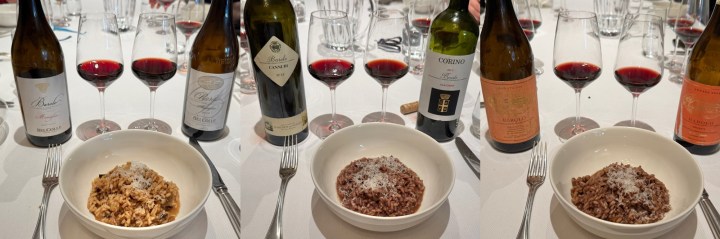
The third course was risotto with dried porcini mushrooms, Italian sausage, and red wine. The risotto was quite hearty and flavorful because of the Italian meat stock I used (brodo di carne) and by ‘mantecare’ with parmigiano. This made the dish a good match for Barolo, although I did try to pick some of the lighter ones from my collection.
- Bel Colle, Barolo Monvigliero DOCG 2009 & 2016
- Marchesi di Barolo, Barolo Cannubi DOCG 2013
- Corino, Barolo Giachini DOCG 2013
- Mario Marengo, Barolo Brunate DOCG 2006 & 2012
Again, the change in wine making seemed to have a bigger impact than the vintage. Bel Colle Barolo Monvigliero 2016 was made in a more modern style than 2009 (more fruity, less extraction, also a different winemaker). The same applied to Mario Marengo Barolo Brunate: the 06 had more extraction than the 12. Corino Barolo Chiachini 2013 was wonderful with an aroma of almonds and cherries. I am going to finish the other bottle of this soon, because seems to be at its peak.
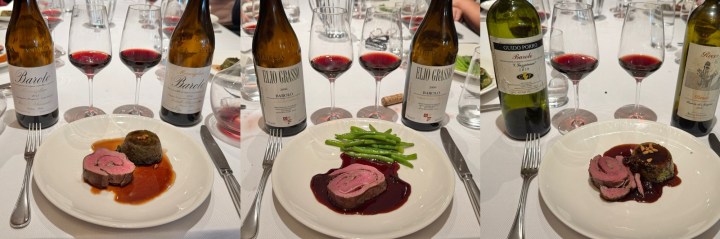
The fourth course was Rosa di Parma, my “go to” dish for Barolo that always makes the wine shine. It is a roulade of beef tenderloin (a very tender meat, but with little flavor on its own) turned into a flavor bomb by stuffing it with prosciutto, garlic, rosemary, and parmigiano, and serving it with a reduction of red wine and beef stock. I usually serve this with spinach tartlets (sformatini di spinaci), but on the second evening, I accidentally switched the contorni between the fourth and fifth courses, which worked well anyway.
- F.lli Alessandria, Barolo Monvigliero DOCG 2006 & 2012
- Elio Grasso, Barolo Gavarini Vigna Chiniera DOCG 2006 & 2009
- Guido Porro, Barolo V. Lazzairasco DOCG 2010
- Rocca Giovanni, Barolo Ravera di Monforte DOCG 2010
Although the winemaker for Fratelli Alessandria Barolo Monvigliero was the same in 2006 and 2012, the 2012 was again a more modern style with less extraction than the 2006. However, we preferred the Elio Grasso Gavarini Vigna Chiniera 2006 over the 2009, as the 2006 was more balanced and elegant while the 2009 had more pronounced acidity. Compared to the 2006 Casa Maté from the previous session, the Gavarini was much more elegant; this makes sense as it comes from more sandy soil, whereas Casa Maté is clay-based. At the dinner in 2025, the 2006 Casa Maté could (and perhaps needed to) still age for some years, but the 2006 and 2009 Gavarini drank very well in 2025.
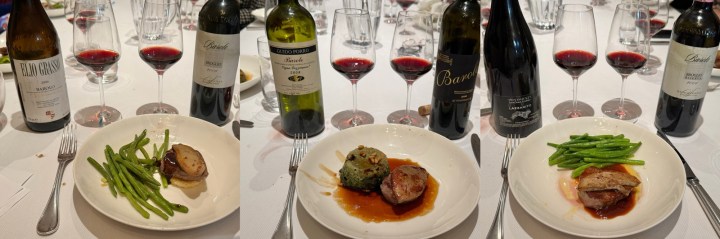
The fifth and final savory course was Tournedos Rossini, filet mignon topped with a seared slice of foie gras and served with a Madeira and beef stock reduction. It is not an Italian dish, but Piemontese cuisine is influenced by the French, and I have even had an interpretation of it at one of my favorite restaurants in the world, Piazza Duomo*** in Alba. In my experience, this dish pairs very well with Barolo, although a riper style, such as the 15% abv Guido Porro Lazzairasco 2008, works best.
- Elio Grasso, Barolo Ginestra Casa Maté DOCG 2006
- Schiavenza, Barolo Broglio DOCG 2006
- Guido Porro, Barolo Lazzairasco DOCG 2008
- F.lli Levis, Barolo DOCG 2008
- Fontanafredda, Barolo Lazzarito Vigna La Delizia DOCG 2004
- Schiavenza, Barolo Broglio Riserva DOCG 2004
The 2006 Elio Grasso Barolo Casa Maté was surprisingly tannic for its age, yet the aromatic development seemed to be fading, so I am not sure if that wine will ever reach a true peak. The Schiavenza Barolo Broglio 2006 was beautiful; I would say it was at its peak in 2025 and better than the Grasso, despite being only about half the price. The Guido Porro Lazzairasco 2008 very also very nice in 2025.
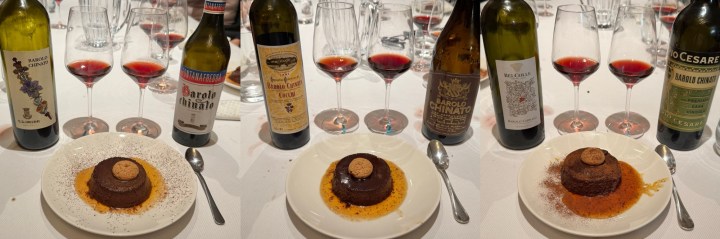
Barolo Chinato is Barolo enriched with sugar and alcohol steeped in spices, especially kina bark, which is also the main ingredient in tonic. Many producers make it, perhaps to use up their less successful stocks of Barolo. I thought the quality varied quite a bit between producers. For instance, Vajra’s Chinato was much better, being more complex and balanced, than the Fontanafredda. The Pio Cesare was also very nice. The choice for dessert was easy, as Bonet, a chocolate and amaretti pudding with caramel sauce, is a classic dessert from Piemonte that I know is excellent with Barolo Chinato.
- G.D. Vajra, Barolo Chinato
- Fontanafredda, Barolo Chinato
- Cocchi, Barolo Chinato
- Tenuta Monfallettto, Barolo Chinato
- Bel Colle, Barolo Chinato
- Pio Cesare, Barolo Chinato
The average price of the bottles I served was just over 35 euros when I purchased them originally and obtaining the latest vintages of the same wines would now be around 50 euros, demonstrating that enjoying a world-class Nebbiolo doesn’t have to break the bank. However, I would caution against supermarket Barolo priced below 20 euros; it is simply not possible to produce a quality wine at such a low price, given the strict production requirements and aging time required by law. While some of these budget options may be drinkable, they rarely reflect the true, complex character that makes Barolo the “king of wines”.
Sharing these 39 bottles with friends and family was the ultimate way to celebrate 15 years of hosting these dinners. Watching even the skeptics among my fellow vinologen be won over, as they enjoyed the Barolos more than expected due to the age and food pairings, was a highlight of the season. To those who still find Barolo a ‘difficult’ king to love: I encourage you to find a bottle with enough age, as drinking it too young is a mistake I often see. Enjoy it with one of the dishes mentioned above using my recipes to prepare them, which truly allow the wines to shine. You might just find your new favorite wine, too.


Came upon this mid-morning twixt complicated local matters. Am used to receiving intricate posts from you – am taken aback at reading such a valuable lesson for my wine knowledge. Am an ‘enthusiastic’ white burgundy drinker with the kind of foods I normally enjoy but actually remember having drunk Barolo on a number of occasions without a current memory to say anything half-way intelligent 🙂 ! Thank you – I am pretty good at studying 🙂 ! Shall surely pass this on! Just looking at the menu you have served . . . two beef dishes following one another > to really compare with the wine ? And – Kees has managed a really good photo of the two of you . . . .
LikeLiked by 1 person